Always keep the lights on with the Apex 300 whole-home power station
Always keep the lights on with the Apex 300 whole-home power station
From severe storm blackouts to off-grid living, here is how this expandable battery system keeps your home running.

Growing up, we had a few power outages here and there, but it was never something we worried about. If it was cold, we’d spark up a fire in the fireplace. If it was dark, we’d bust out the oil-filled camping lantern, flashlights, and candles. We never worried too much about whether we could watch TV, and getting online wasn’t nearly as important as it is today.
Now, when the power goes down, we go down. Many of us work from home, so not having power can pose a major issue. No internet means no work, and for many, that could potentially mean no paycheck. Even kids often need to get online to do their homework. And increasingly, many homes rely heavily on connected tech and smart devices, so losing power can bring daily life to a halt. That’s where the Bluetti Apex 300 comes in clutch.
Everything you need to know about Bluetti Apex 300:
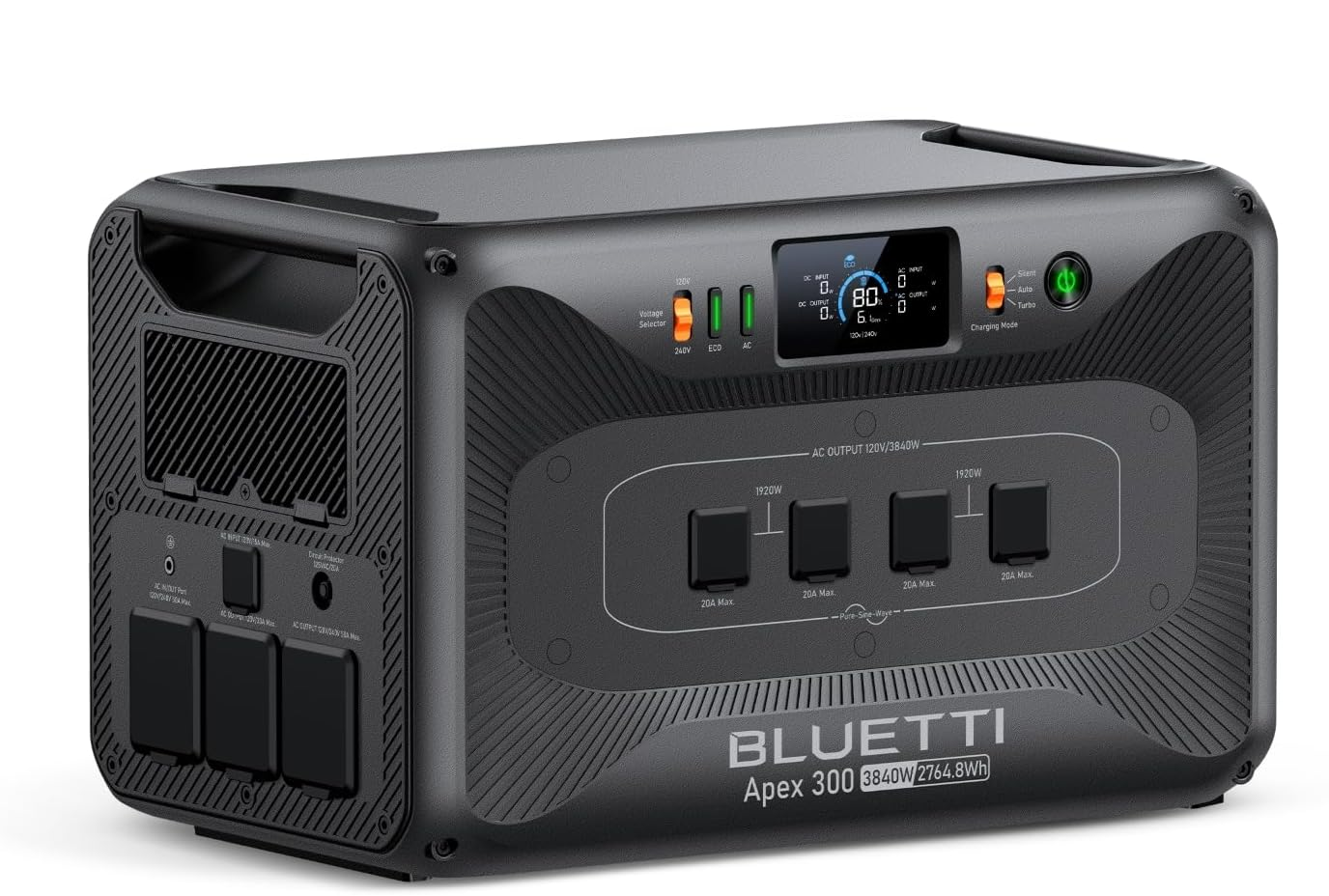
Bluetti Apex 300 Power Station
$1,699
Keep the lights on
I was recently reminded of how important backup power can be when a series of storms rolled through New Jersey in early July. The biggest storm didn’t look bad at first — it rolled through in under an hour — but left thousands in my area without power for days (some close to a week!) as it tore down trees and downed power lines for miles around. We were without grid power for nearly 36 hours, but thankfully, I had a backup solution in place for just such an emergency.
Whole-home generators can be expensive. We already have natural gas, so hooking one up wouldn’t be too much of an issue, but the cost — and noise — are things I haven’t yet come to terms with. Thankfully, there are other solutions that get the job done and do it even better in many cases.
While larger portable power stations aren’t all that new, whole-home solutions are just starting to be more widely adopted. I’ve used various power stations over the years, ranging from smaller, super-portable units to larger, not-so-portable ones. Many of them were suitable for keeping my fridge going while powering a few lights or a fan, but nothing was a true full-home backup solution. It wasn’t until I came across the Bluetti Apex 300 system that I really went all-in on a backup battery for the entire house.
Whole home backup
Having a whole-home solution is ideal for anyone who wants to stay powered when the grid goes down, or, more importantly, those that emergency devices like medical equipment that rely on constant power to stay operational. While gas generators have their place, they are costly, need to be placed outside, and are loud and difficult for many to manage. A battery system can be easily placed in a garage or basement; it’s completely quiet and extremely easy to manage with an app. What’s more, most systems can be added onto, giving you multiple options for expandability. The flexibility that they provide allow you to start small, then expand your system as your needs increase.
For me, the choice was the Bluetti Apex 300 along with multiple BK300 expansion batteries. I started my system with just the Apex 300 and two batteries, but it’s since grown to five expansion batteries. While I don’t have an advanced connected electrical panel (yet), I did have an interlock installed on my existing panel, giving me the option to manually switch power from the grid to the Bluetti. It’s an added step that I hope to remedy one day, but for now, it does the job. When the grid goes down, I just have to flip on the panel, plug in the system, and we’re back up and running in minutes.
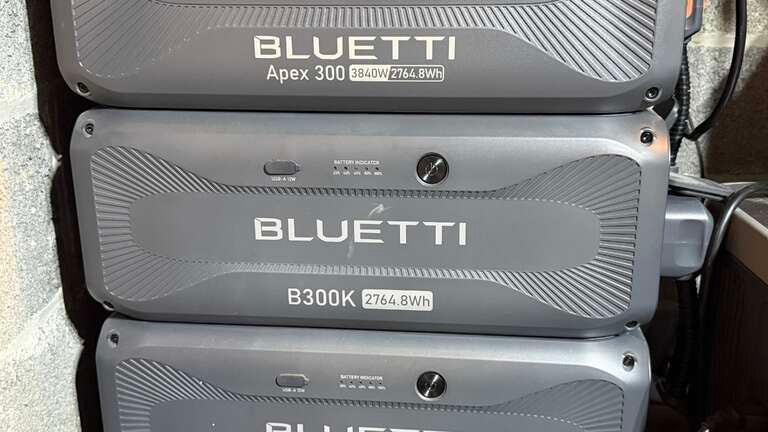
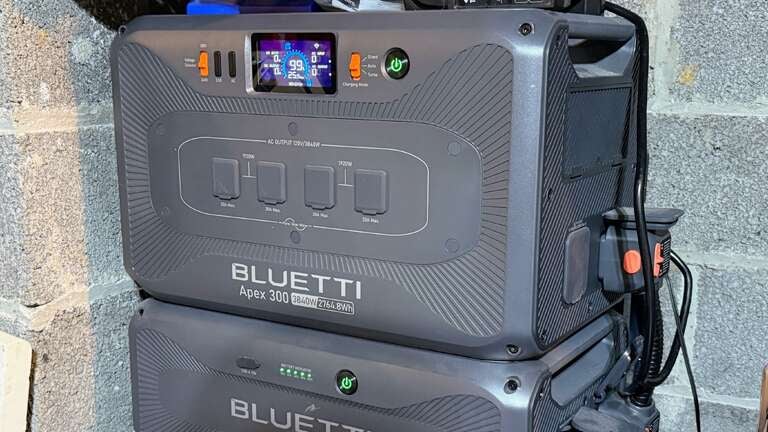
My setup consists of one Apex 300 unit that leads the charge, with five BK300 expansion batteries rounding things out. While they do take up a good amount of space, I’ve managed to carve out a dedicated corner of my basement to keep everything ready until it’s go time. The benefit of a setup like this is that there’s no gas to buy and no engine maintenance required. Just charge up the system, and it’s ready to go. It holds a charge for months, so I rarely even need to top it off.
As I said, I don’t have any sort of smart panel to monitor the setup, but I check on it every few weeks or right before an impending storm to ensure it’s ready for whatever comes next.
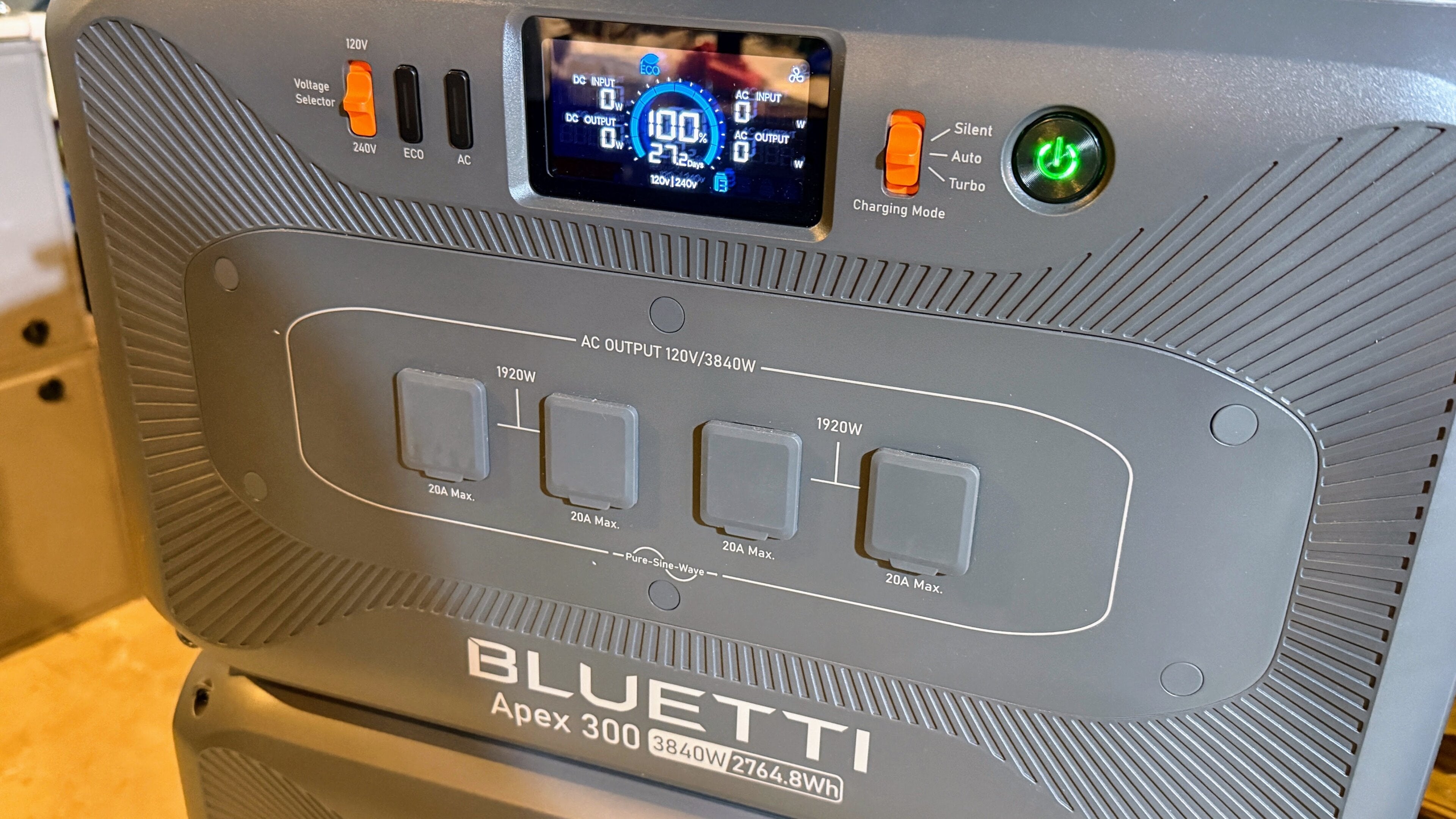
Here’s what the Apex 300 is packing:
Internal Capacity: 2,764.8 Wh (LiFePO4 chemistry, 6,000+ life cycles)
Continuous AC Output: 3,840W total (7,680W Power Lifting Mode)
Output Voltages: Simultaneous 120V and 240V dual output
AC Outlets: 4 × 120V/20A, 1 × TT-30R (120V/30A), 1 × NEMA 14-50R (120/240V 50A)
DC Outlets: 2 × 100W USB-C, 2 × 15W USB-A, 12V/24V ports, 1 × Anderson Port
Solar Charging Input: Up to 2,400W dual MPPT (expandable up to 30kW via SolarX 4K)
Grid Charging / Bypass: Up to 3,840W Turbo AC input; 12,000W / 50A grid bypass capability
UPS Functionality: 0ms transfer time
Dimensions & Weight: 20.67 × 12.87 × 12.6 in; 83.8 lbs (38 kg)
My system overall:
Total Energy Capacity: 16,588.8 Wh (16.6 kWh) — 1 × Apex 300 (2,764.8 Wh) + 5 × B300K (13,824 Wh)
Max Continuous AC Output: 3,840W continuous (7,680W surge/lifting mode)
Max Charging Input: Up to 6,240W combined (AC + Solar direct input)
Total System Weight: ~400.3 lbs (~181.5 kg) total combined footprint
This all sits neatly on a stack in my basement, tucked away and always at the ready. It does take up a good amount of space, but it’s also well worth the tradeoff when the power goes out.
More power!
Powering devices is really just lots of math when you break it down. How much power the setup is pushing vs. how much power the stuff I want to use is drawing. Ideally, I just need to make it through a few days, but it could, of course, be much longer. My setup puts out enough power to keep my fridge running for a few days, power essentials like lights and maybe a few appliances (I need my coffee!), and charge our various devices. Beyond that, we try not to use anything we don’t have to.
During an outage, I change over the interlock on my panel, plug in the Apex 300, and fire it up. The benefit of having the system run through the panel is that I can selectively choose which breakers to use, meaning essential devices like the refrigerator, bedroom lights, and ceiling fans stay on, while non-necessary devices like my son’s PlayStation 5 can stay off. Depending on the situation, we’ll power up the TV and internet as well, for which the Apex300 provides plenty of juice.
For extended outages, I also have two large 400W solar panels that I can use to charge everything, but thankfully, I haven’t had to pull them out yet. The Apex 300 setup also provides pass-through for a generator, so if you do have a gas generator, you can use it to charge during the day when you don’t mind the noise, then leave it off at night and let the Apex 300 do its thing.
Native 240V capability
The true game-changer of a system like the Bluetti Apex 300 isn’t just its capacity; it’s the native 240V dual-voltage output. Many portable power stations are strictly limited to 120V output, meaning they can charge devices or run small appliances, but won’t cut it if you try to power your whole house. Heavy-duty home infrastructure — like well pumps, central AC, washing machines and dryers, and electric water heaters — requires 240V power. I don’t think many of us will be doing laundry when the grid power is down, but you never know!
By incorporating a dual inverter that delivers simultaneous 120V and 240V current through a NEMA 14-50R outlet, the Apex 300 operates like a traditional, larger gas generator, giving you more power for bigger things.
Real-World Performance
In practice, having this much storage tied directly into the electrical panel takes a huge load off when the grid goes down. When my neighbor’s gas generator fires up outside, my battery setup operates in total silence (okay, there’s an extremely low hum at times) from a corner of the basement. That amount of reserve capacity easily powers essential 120V circuits — like a refrigerator, router, ceiling fans, and necessary lighting — potentially for a few days straight without needing to recharge. If I need to power something larger like my HVAC, the Apex 300’s continuous ceiling and 7,680W surge rating absorb the initial startup spike, keeping basic home comforts running without tripping the breaker — though I don’t do that often since it obviously eats through the battery.
The app is just okay
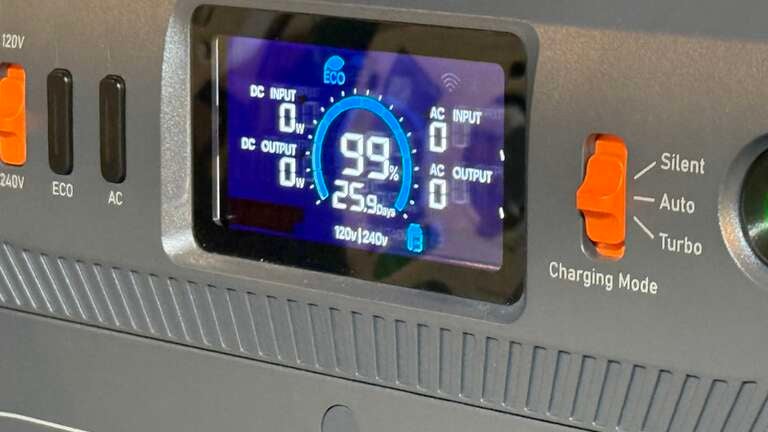
While the Bluetti app isn’t my favorite and could be much more intuitive, it does get the job done. It’s a bit clunky at times and somewhat hard to navigate if you don’t know exactly what you’re looking for, but it still gives you everything you need to keep the system running. I can see the charge status and levels for all my devices, including power in, power out, eco mode, and everything in between.
When the Apex 300 is in use without grid power, it shows exactly what’s being pushed out as well as an estimated time remaining, which, in my testing, is fairly accurate, but thankfully, I haven’t had to run it down to zero yet either. I do think it would be better to show the connected B300K devices instead of grouping them as it does. I have trouble at times if any of the stack isn’t connected, making it hard to tell if everything is up and running properly. But hey, at the end of the day, it still works.
Keep the juice flowing
Thankfully, I’ve only had to use this to power my house twice since I’ve gotten it, once for a few hours and once for a bit more than a day. In both cases, I’m extremely glad it was ready to go when I needed it, with no gas cans to fill, no generator to haul outside, and no candles to light.
Having to manually flip the interlock on my panel is a downside, sure, but I’ll trade it for clean power everywhere I need it during an outage. I can keep my refrigerator running, power on essential lights, run the coffee maker, and, if I need to, have the heat running for a short period to keep things comfortable.
The real benefits here are that there’s no gas to worry about, nothing to store outside, and the system is always at the ready when I need it. It’s expandable, should I ever need to change things up, and I can easily monitor the status or make adjustments through the app. At some point. I’d love to upgrade to a smart panel to make the changeover easier and more seamless, but for now, what I have gets the job done.
When it comes to pricing, a setup like this is definitely expensive. The Apex 300 alone will set you back $1,700 on a good day; a B300K is another $1,200, and in most cases, you’ll want more than one of those. So you’re looking at $4,000+ — probably more in the $8,000- $10,000 range if you want something that will actually keep most of the house running during an outage. It’s costly, yes, but also gives you peace of mind. Plus, compared to a traditional whole-home or gas generator, there’s no gas cost and no maintenance, so you’re saving in other places as well. You can also start out small and build up your system over time.
If you suffer from frequent power outages or just want something as a “just in case” backup, the Apex 300 is definitely worth exploring.
Bluetti Apex 300 Power Station
$1,699
The Apex 300 is a versatile, high-capacity power station offering dual-voltage (120V/240V) output and 3840W of power to easily run heavy appliances, RVs, and EV chargers.