Streaming has robbed sports fans of the joys of channel flipping
Streaming has robbed sports fans of the joys of channel flipping
Oh how I miss the tactile, visceral immediacy of flipping through channels on an especially busy sports day.

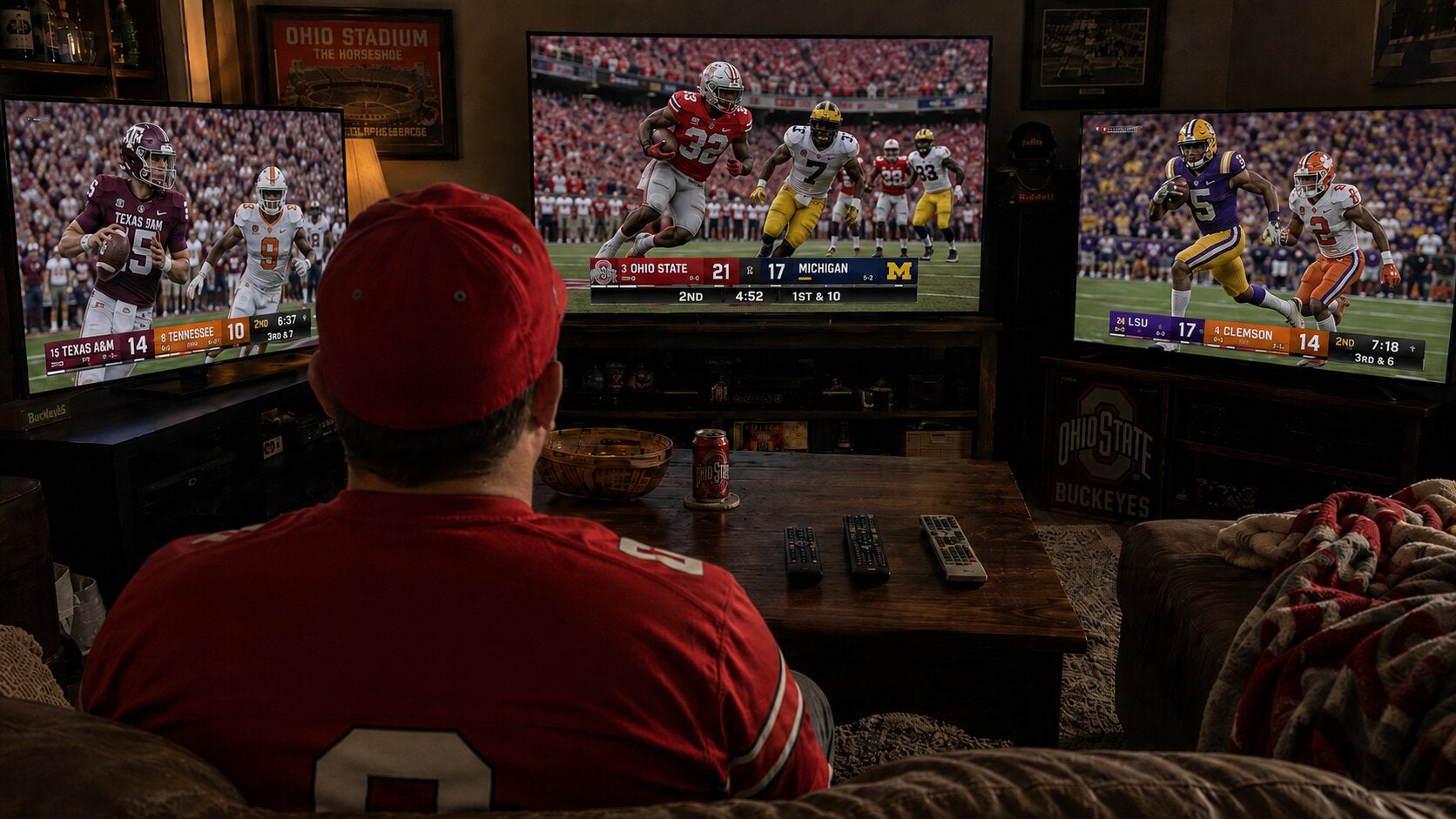
With the NBA and NHL Postseasons now complete, the World Cup into the knockout stages, Major League Baseball heading into the All-Star Break, and the World Series of Poker in full swing — not to mention my beloved college football just two months away — I have enjoyed watching sports over the past few weeks more than I have in a long time.
But even as the quality of the action has been thrilling, it still feels as though something is missing. Not from the games themselves, or even the broadcasts specifically, but instead on something far more experiential, more tactile, more visceral.
There was a time in the not-so-distant past when watching sports felt less like hunting through a dozen or so streaming services to laboriously find the one game you want to watch, and more like conducting an orchestra; there was a rhythm to it, an instinct, dare I say, a skill.
I am, of course, talking about the time-honored tradition now lost to antiquity known as channel flipping.
Back in the day, you could flip from the 50-yard touchdown pass on ABC to the field goal attempt on ESPN. From that kick on ESPN to the fourth down defensive stand on CBS. From the stand on CBS to the interception on Fox. From pick on Fox to ESPN2 to check in on your favorite mid-major. Then, finally, back to ABC just as they come back from the commercial break.
The remote was an extension of your hand. Channel numbers were muscle memory. You didn’t “navigate” television; you flowed through it, stopping momentarily at each of the major tributaries on your journey for a momentary respite, catching up on all of the action happening at once. Unfortunately, streaming — for all of the legitimately wonderful things it has afforded sports fans — has quietly killed a huge part of that experience.
This lost aspect of sports viewing was, of course, not intentional. Modern live TV streaming is objectively better in plenty of ways; high-definition viewing is exponentially better than the old-school standard-def pictures we got in the past. There are dramatically more games available to watch than in the days of basic cable. And I would never trade away my beloved multiview features.
But somewhere along the way, we lost the art of — and even the ability to — channel flipping.
If you, like me, are of a certain age and are the type of sports sicko who spends fall Saturdays monitoring north of 18 games simultaneously across three televisions, a laptop, and an iPad, you likely feel this loss as acutely as I do. The biggest problem with modern sports streaming isn’t necessarily buffering; it isn’t price increases; it isn’t even fragmentation, although, yes, I will get to that.
The real problem is inimmediacy: it’s a second lost here, an extra menu to navigate there, an interminable loading wheel, a guide that forgets what you were doing, a remote with all the functionality of an inoperable hotel thermostat. Over the course of a game day, those little inconveniences change the rhythm of sports watching, turning it into something less that you control, and more that you have to endure.
Traditional cable flipping felt instantaneous. You hit “Last,” and boom, you were back. You could bounce between games during huddles, commercials, free throws, pitching changes, replay reviews, or whenever you just got fed up with having to listen to Gary Danielson or Tim Brando blather on about something that they clearly didn’t understand. Flipping was not only immediate, it was instinctive. You could get in the zone, just like the players you were watching, and when your brain and fingers were wholly in sync, you began executing on a heretofore unseen level. It felt like floating, an almost-out-of-body euphoria that was part possession, part psychic ability, and part Mensa-level genius.
But streaming does not provide the framework for those experiences even more. Even on the best live TV streaming services — DIRECTV, Sling TV, YouTube TV, Hulu + Live TV, Fubo — moving between channels usually involves some kind of delay. Maybe it is only a couple of seconds, but sometimes it is five or more. Occasionally, when loading a new channel, the picture takes a few extra moments to fully pixelize, meaning the first few images are more akin to 8-bit than HD. And let’s not forget about the possibility that the app crashes and forces you back to the main menu.
None of those options, on their own, is really that big of a deal, but in sports, two seconds is an eternity, and 10-15 seconds can change everything. It is the difference between seeing a play from the snap and having to settle for the replay of the resulting touchdown. It is the difference between seeing a game-changing play happen versus being spoiled by text messages and social media posts from viewers 20 to 30 seconds ahead of you. It is frustrating and completely spoils the joy and investment that flipping used to bring to sports fans.
That brings us to the other delay problem: being behind the world. Live streaming is often not actually “live” in the way sports fans emotionally understand it to be. Latency is the gap between when the camera captures an event and when it appears on your TV, and it has always been a part of sports broadcasting, regardless of the medium.
While network and cable broadcasts are roughly 7 to 8 seconds behind the action (thanks to those famous FCC-mandated network delays), at their best, streaming services are 15 to 30 seconds behind, and that’s not accounting for slower internet connections, paused streams, or mid-action flipping. Regardless, the broader point remains: different platforms, and even different devices in the same room, can put fans in noticeably different moments of the same game.
That is fine if you are watching “House Hunters,” it is less fine when your group chat, fantasy app, push alerts, and everyone on social media spoil the excitement of the game by knowing about a touchdown long before you do. For many of us, having a second screen focused on social media during a game is an invaluable source of insight, community, stats, and replays that has become an ingrained part of our sports-viewing experience. However, the inevitable feeling of being spoiled by someone with lower latency has begun forcing me to only turn to Twitter during commercial breaks, meaning that streaming has stolen yet another source of my viewing enjoyment.
From a channel-flipping perspective, this latency issue also makes it very difficult to time things up. We used to know exactly how long a TV timeout would last. We knew in our bones how long a team would take between plays, and if all of the planets aligned, for one precious moment in human history, we could flip nearly non-stop, bouncing from play to play to play as if the ghosts of Howard Cosell, Keith Jackson, and Jack Buck were all guiding our fingers with a knowledge from on high.
However, with latency and buffering issues throwing off the timing of streams, in addition to the multiple seconds it takes to simply change channels, it’s nearly impossible — despite any spectral assistance — to be in sync with the natural rhythms of the modern game.
Another aspect of streaming that has all but destroyed the art of channel flipping is the aforementioned fragmentation of media rights. The technical restraints of live TV streaming services have essentially made the art of channel flipping obsolete. But the thing that has damned it to the dustbin of history is the fact that, nowadays, not every game you are interested in is going to be available on a single streaming service.
That means that if I want to flip between the Ohio State game on Fox and the Notre Dame game on Peacock, I have to completely exit YouTube TV, boot up Peacock, find the game on the platform’s menu, and wait for it to load. The problem is that the process of simply getting to the game generally takes longer than two or three plays, negating the entire purpose of flipping to the game in the first place.
The other fragmentation bummer is that I can’t incorporate those games into my streaming multiview setup. On college football Saturdays, I will have my main 75-inch TV either on my alma mater, the Ohio State Buckeyes’ game, or a multiview of the top four games in that specific window.
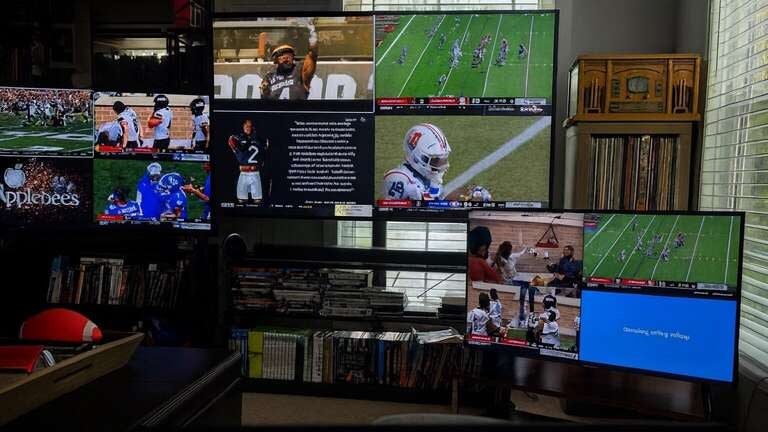
On my secondary 55-inch TV, I will have the next-best four games, and on my side 40-inch screen, I will generally have a streaming-exclusive game. The problem is that, because I root for a Big Ten team, the games that usually end up only on Peacock are often ones that I am interested in. So, in a perfect world, I would have them front and center on the big TV. Instead, they are relegated to the runt of my TV litter, simply because they have to stand alone on a service that otherwise wouldn’t occupy one of my screens on gameday.
Another lost aspect of channel flipping that I miss is actual channels. For decades, sports fans built mental maps of their respective television lineups. For me, ABC was 6, NBC was 4, Fox was 8, CBS was 10, ESPN was 32, TNT was 45. Your fingers knew how to get to the next channel; they moved across the number pad on their own volition, requiring only the faintest of thought to get you to where you wanted to go.
But streaming services have replaced that numeric flexibility with the more rigid app-centric navigation. Networks became tiles, menus, logos, rows, recommendations, and giant rectangles in carousels that require four extra clicks to get you to the place you actually came to the app to be. Even the remotes reflect the change. Old cable remotes looked like calculators designed by people who feared simplicity and embraced the freedom that our hundreds of channels afforded. Streaming remotes are sleek, minimalist, elegant, and often kind of terrible for sports.
Most streaming remotes assume you are choosing content, not surfing through it. Watching television has become more intentional and less improvisational, and, unfortunately, sports viewing has always thrived on improvisation. Channel flipping created accidental fandom moments: a MACtion shootout in the noon window as the bigger games wound down, a Mountain West matchup gone beautifully sideways, and (in my mind) the reason that Philo T. Farnsworth invented television in the first place, discovering the most bonkers Pac-12 After Dark game in the history of sports.
Streaming prioritizes “content discovery” over ease of finding what you want, and not by accident either. The thought is that while you are trying to navigate the labyrinthine maze to find the show you want to watch, if the streamer presents you with myriad other options, complete with colorful images and auto-play trailers, you might add a new title or 12 to your watch list, keeping you engaged and invested in the platform.
But from a sports-watching perspective, that level of detour is not a feature, nor a bug; it is a roadblock, making me far more likely to give up on said streamer, rather than having to frustratingly flip through its multiple layers of unnecessary steps to get to what I want. I miss the days when a simple push of a numbered or Back button would immediately take me to what I wanted to see, no seconds-long delays or inconvenient extra steps required.
Streaming did not ruin sports watching; in many respects, it improved it dramatically. But in solving so many old television problems, it also erased a very specific kind of joy: the tactile, impulsive, beautifully inefficient art of flipping around on a big sports day and seeing where the chaos took you. Channel flipping was active, chaotic, and exploratory. While the old experience felt like discovering all that the TV day had to offer, the new experience feels like being forced to sit passively on the couch and be satisfied with what we have in front of us; the technological equivalent of “This is what we are having for dinner, and you are going to eat every last bite and like it.”
For those of us who still instinctively reach for a “Last Channel” button that has long been extinct from streaming remotes, the loss of the thrill that channel surfing could provide, the exhilaration of bouncing between games, the elation that timing a flip up just right could provide, is something that I will never not mourn, despite all of the other legitimate benefits that streaming has brought into our sports-viewing lives.
Live TV Streaming Find out more >
Service Matchmaker
Our Matchmaker lets you compare multiple channels across all live TV streaming services. Just tell us what you watch and we’ll handle the rest.


