Survey: Live TV is Still Default Starting Point for Most Viewers, But Smart TV Apps Overtake the Set-Top Box
Survey: Live TV is Still Default Starting Point for Most Viewers, But Smart TV Apps Overtake the Set-Top Box

It’s entirely possible that television historians will look back on the early 2020s as a period of fundamental transition for TV watching habits. This could be the era where TV transitions from linear broadcasts to a primarily streaming format, and new data from Hub Research is underscoring how far things have already progressed.
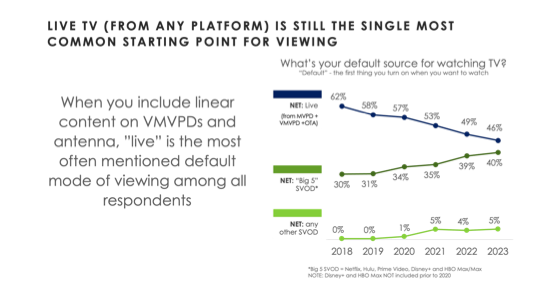
First, the good news for linear TV. Hub’s data shows that live TV from any platform (antenna, cable or live TV streaming service is still the way most viewers start watching TV. Live viewing was the most-chosen default mode of TV watching for 46% of respondents to Hub’s survey, whereas one of the so-called “Big 5” subscription video-on-demand (SVOD) services (Netflix, Disney+, Hulu, Prime Video and Max) was the default for 40%. However, the number of respondents who chose SVOD services first has risen steadily since 2018.
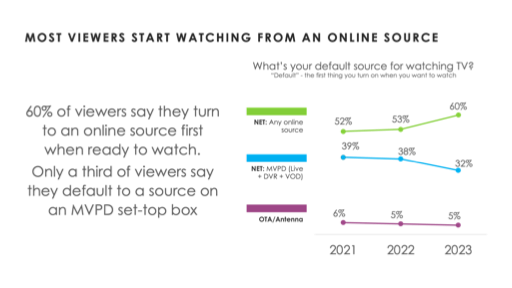
Now, the bad news for traditional cable. Hub’s data also found that the set-top box, once so ubiquitous in the American household as a necessary addition to every cable plan, has fallen way behind internet-based sources of TV as a first stop for viewers. At a rate of 60%, respondents said they turn to an online source first when ready to watch. Less than a third of viewers (32%) said they went to their cable box first when they were about to turn on the TV.
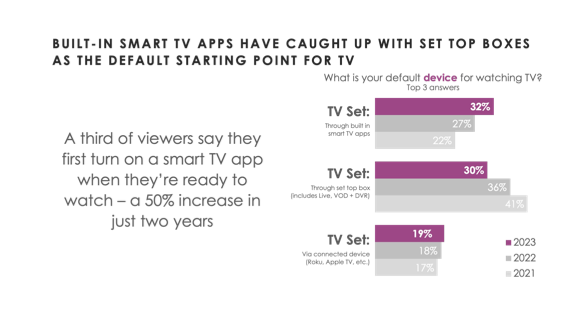
The survey from Hub also speaks to the proliferation of smart TVs in the United States. Over half of all television sets in the U.S. are smart TVs, and Hub’s data shows that smart TV apps are the first go-to for 32% of audiences when they want to watch TV. Smart TV apps have overtaken set-top cable boxes as the first stop for viewers for the first time in 2023, as those devices are chosen first by just 30% of users.
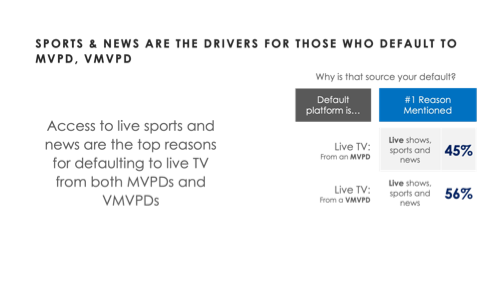
As expected, one of the big reasons users who default to live TV do so is because that’s the best source for live news and sports. Live programming like news and sports was the top reason given by 45% of users who seek out live TV first, and that number jumps to 56% among users of live TV streaming services, also known as virtual multichannel video programming distributors (vMVPDs).
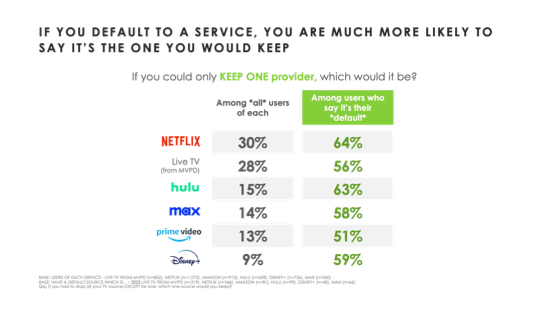
In an age where the U.S. streaming market is saturated, it has become critical for SVOD apps to become the default for customers who say they go to a streaming service first when turning on the TV. Customers are much more likely to keep a streamer they identify as their default, and as prices increase across the streaming landscape while competition remains fierce that is a key statistic.
“In order for providers to retain customers in the competitive streaming video marketplace, it’s critical to be a first choice for viewing,” said Mark Loughney, senior consultant to Hub. “As viewers are increasingly defaulting to online video sources and relying on apps as a starting point, it’s essential to be among those that are installed on smart TV menus.”
The data from Hub shows why carriage deals like the new agreement between Disney and Spectrum may become more common. Television is in a definite period of transition, and deals that give cable subscribers login credentials to subscription video services will help convert users who identify live TV as their go-to source of viewing onto streaming platforms like Disney+.

Disney+
Disney+ is a video streaming service with over 13,000 series and films from Disney, Pixar, Marvel, Star Wars, National Geographic, The Muppets, and more. It is available in 61 countries and 21 languages. It is notable for its popular original series like “The Mandalorian,” “Ms. Marvel,” “Loki,” “Obi-Wan Kenobi,” and “Andor.”