Report: Cable Customer Pays More than $1,600 per Year for Channels They Don’t Watch; What Lessons Can Streamers Learn?
Report: Cable Customer Pays More than $1,600 per Year for Channels They Don’t Watch; What Lessons Can Streamers Learn?

Cable and satellite providers know their time as a major source of entertainment for Americans is nearing an end. A survey from February found that only 48% of households in the United States have a cable subscription nowadays, and now more data has become available regarding just how tenuous cable’s hold on American audiences is.
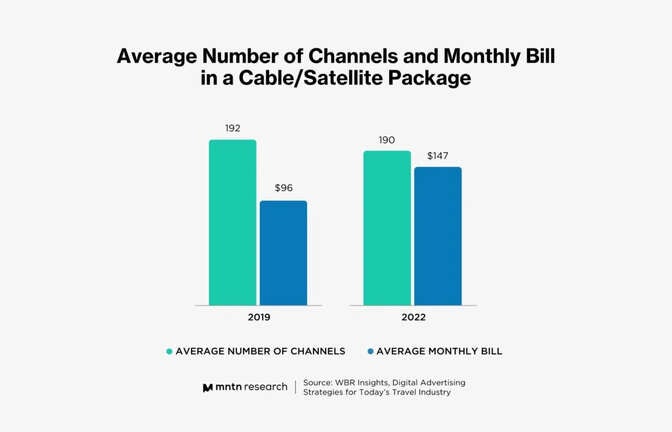
The data comes from MNTN Research, which cites figures from WBR Insights that indicate the price of cable subscriptions is going up, while the channel offerings from providers are falling. In 2019, the average cable/satellite package had 192 channels and cost $96 per month. In 2022, the channel count has dropped to 190, while the bill has risen by more than 33% to $147.
Cable operators are feeling the pinch of cord-cutting on one side, and demand for increased carriage fees from network owners on the other side. To try to solve this financial dilemma, they are passing the costs of higher carriage fees onto the smaller pool of consumers they have left. This is especially unacceptable to consumers because on average, they watch so few of the channels they pay for; consumers report regularly watching just 15 of the average 190 channels they get with a cable subscription, according to MNTN and American Express Travel’s numbers.
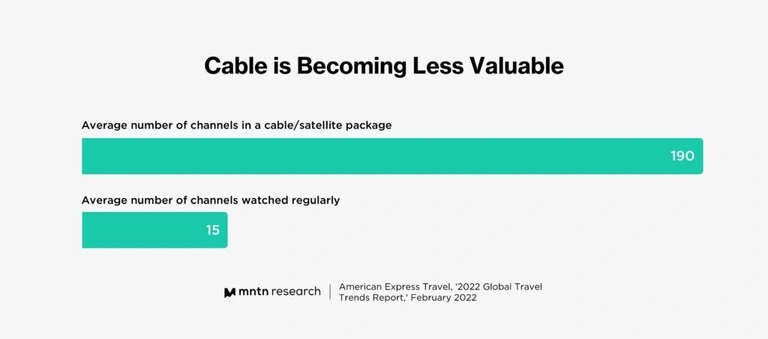
Some quick math indicates that at 190 channels for $147 per month, the average customer pays $0.77 per channel. Subtracting the amount users pay for the 15 channels they actually watch, users are paying $135 per month ($1,618 per year) for networks they don’t regularly access. Given that information, it’s no wonder that four out of five linear TV customers wish they could pay for just the channels they watch, similar to the streaming model.
This is a lesson that streaming providers will need to pay close attention to in the future. The problem for customers is, cable and streaming are built on two very different business models. Cable’s model relied on users who didn’t watch certain channels helping to pay for users who weren’t watching those channels to keep costs lower. When pay TV had hundreds of millions of customers at its height, that model worked just fine.
But now penetration of pay-TV is at its lowest point since 1993, and there simply aren’t enough users paying into the system to keep costs low for the customers that are still there. Users who are begging for more a la carte choices when it comes to TV might actually get it, but it likely won’t be as cheap as they are anticipating it will be.
Take ESPN, for example. Users have been wishing for a streaming version of the ESPN family of channels that didn’t require a pay-TV subscription ever since streaming video became a viable source of entertainment. But now that the process of offering a streaming-only version of ESPN has reportedly begun, some are estimating that it could cost between $30-$40 per month at a minimum, due to the high prices the network must pay to secure broadcasting rights for the most popular sports.
Not all cable networks will have to worry about paying for sports rights when determining if they can offer streaming-only versions of their channels, but they’ll also have to play nice with their competition to keep streaming versions of their channels aggregated in one place. If they don’t—if users hypothetically have to go to the Nickelodeon website to stream that channel, then switch to the TNT app to watch that network, it will simply be a rehash of the frustrations users are experiencing now thanks to the glut of subscription video services available.
Despite the figures from MNTN, the death of cable and satellite will not be an overnight prospect. Providers still have some time to figure out what comes next, but for streamers the message is clear. Customers want the ability to choose for themselves and not spend money on content they don’t watch, and streamers must take this fully into account when deciding how to offer content from cablers moving forward.