The spread of sports rights on TV has gone too far
The spread of sports rights on TV has gone too far
Customers are fed up with the increasing difficulty of finding their favorite sports, and it’s beginning to spur action at the highest levels of government.

The NFL is widely expected to secure an unprecedented amount of money for its TV rights the next time it negotiates its contracts — which could happen before the 2026 season. Unfortunately for fans of the league, however, that cost will trickle down; paying more for NFL rights means that the channels carrying games will have to ask for more from distributors like DIRECTV, Fubo, YouTube TV, etc., who, in turn, pass the higher prices onto their customers.
Leagues like the NFL are able to earn more for their sports rights in one of two ways. One, simply asking (or demanding) more money, or two, creating new packages of games to sell to new distributors. The NFL will certainly use Method 1 in its next round of talks with programmers, and has already engaged in the second method.
In recent years, the league has introduced new deals with Netflix for games on Christmas Day and with YouTube for last season's Friday-night opener. But fans can only be pushed so far; new data indicates that viewers are fed up with games airing on an increasing number of channels and platforms, and lawmakers are finally starting to pay attention to the plight of constituents. Ultimately, fans just want to watch their favorite teams play without needing an advanced college degree to figure out how to do it.
Data from Hub Research shows that 87% of sports fans report being frustrated with how hard it is to find where to watch their chosen sports and teams. Almost 25% say they are “very frustrated” by the process, and while aggregation hubs like Where to Watch on the ESPN and Roku’s Sports Zone are helping, they aren’t enough.
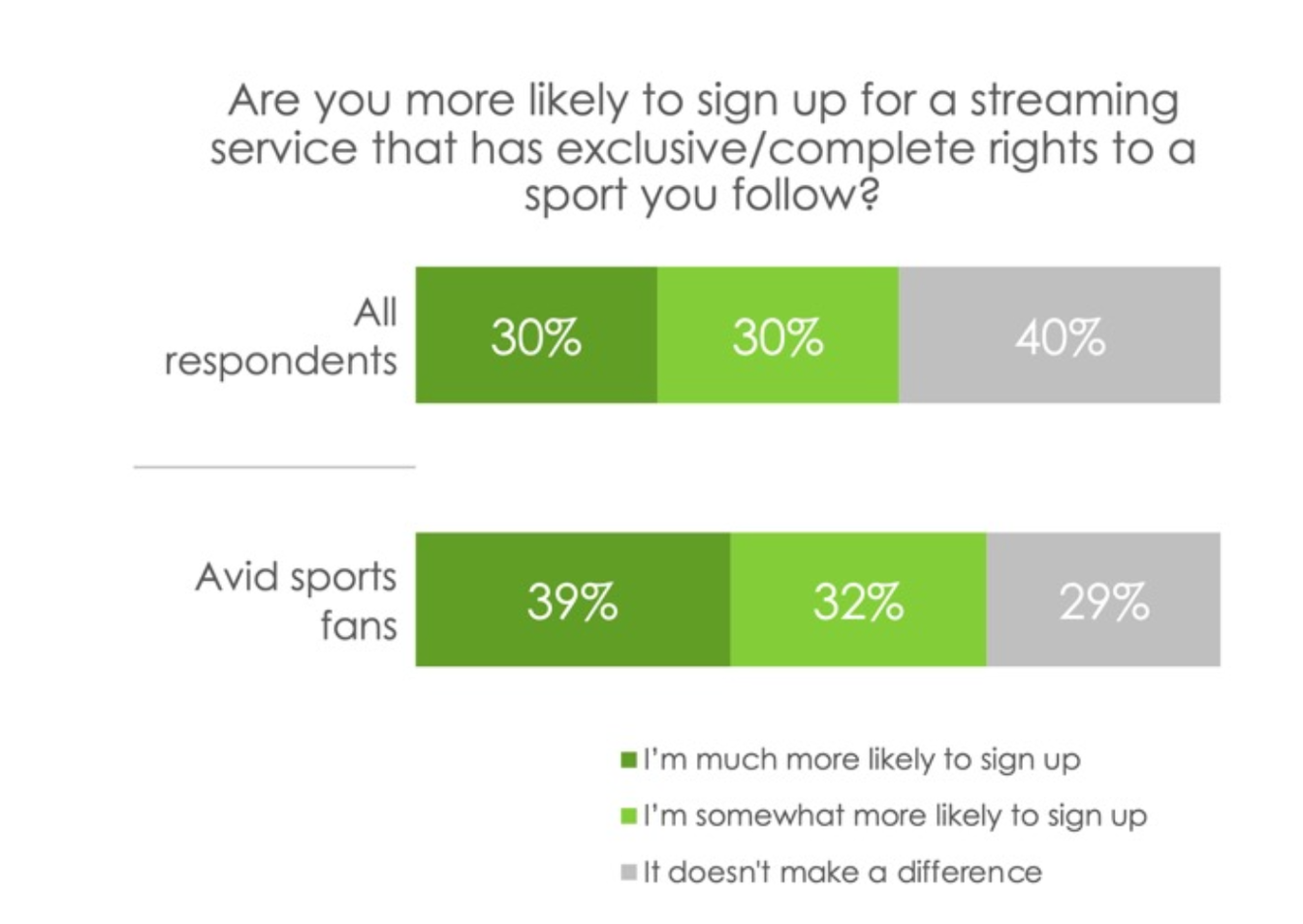
The data suggests that, even with tools like those, 60% of sports fans say they’re more likely to sign up for a service that carries rights to all the sports they follow, rather than having to piecemeal coverage across various platforms. Among avid fans, almost 40% say they are “much more likely” to sign up for an all-in-one service.
The financial consequences of live sports proliferation are no doubt leading to fans’ desire for consolidation. A recent study found that the average monthly price of watching live sports has risen to nearly $123 per month, and it’s fair to wonder how much further fans can be pushed before leagues and broadcasters begin to see pushback from viewers.
Distributors are trying to combat the problem by introducing sports-only channel packages that still carry networks from multiple programmers, but don’t include entertainment channels. DIRECTV, Fubo, and YouTube TV have all launched sports-specific channel plans, but even these can’t drop the price as low as customers would like, charging between $56 and $70 per month.
Stacking direct-to-consumer apps as an alternative nominally allows viewers more control over which sports they watch, but this can cost just as much as a sports-only live TV service once the stacking is complete. And worse, it significantly degrades the viewing experience, forcing fans to log in and out of various platforms to move between games.
American legislators are finally being pulled into the fray to defend consumers. This month, Senator Mike Lee (R-UT) asked the Department of Justice and the Federal Trade Commission to review antitrust exemptions built into the 1961 Sports Broadcasting Act to see if the NFL’s current distribution packages align with that law. At a 2025 hearing, senators from both parties questioned league executives on their practice of splitting up their rights among so many different distribution partners.
Will these inquiries lead to legislation that makes it easier for the American sports fan to watch their favorite teams and leagues? Considering the speed at which the government usually works, such a law is probably a long way off. But leagues that see legislative action as a real threat could be motivated to act on their own to lower barriers to access games before Congress can get involved.
The dissolution of the regional sports network (RSN) framework that distributed games from the NBA, NHL, and MLB has created a new wrinkle for viewers. These channels were once part of the ubiquitous cable bundle, but the biggest RSN companies have now shut down or announced their intention to do so. The NBA and MLB are trying to step in to create special streaming services to offer these games to fans in the future, but such services could exacerbate the problem.
Yes, they will pool in-market games from as many teams as possible into one streamer, but they will also be distributed by third parties like DAZN or ESPN. Does that mean that a fan will need an extra subscription to watch the games, as well? Those questions aren’t yet answered, but leagues have to take care not to raise new obstacles to fan access as they are trying to lower others.
There’s another problem for leagues that chase money by dividing their game packages among as many distributors as possible: young viewers. Recent data found that streamers already have more trouble retaining young subscribers than any other age group, and Gen Z and Gen Alpha members have grown up watching free video services like TikTok and YouTube. They’re not going to be easy to convert into customers that shell out hundreds of dollars per month to watch one team’s games on five different subscriptions.
One thing is clear: the status quo won’t hold with fans much longer. Hub’s data shows that viewers are growing more and more frustrated with the amount of effort it takes to find games, and their wallets can only be stretched so far before they snap and decide to walk away. Leagues like the NFL have to ensure they don’t attempt to push their games to too many distribution partners, and may want to scale back their current efforts in that regard, lest Congress do it for them.

YouTube TV
YouTube TV is a live TV streaming service with more than 60 channels for $82.99/month. This plan includes local channels 32 of the top 35 cable channels, and regional sports networks (RSNs) in select markets. The base plan includes more than 100 live channels, including major broadcast networks like ABC, CBS, FOX, and NBC, as well as popular cable channels such as ESPN, CNN, FX, USA Network, and TNT. Local channels are included in most markets, making YouTube TV a full replacement for traditional cable for many viewers.