Streamers’ focus on crowd-pleasing shows is confusing viewers
Streamers’ focus on crowd-pleasing shows is confusing viewers
A new report from Hub Research shows that customers are having a harder time telling streaming services apart.

In theory, the strategy of making content that appeals to everyone would seem to make sense for streaming services. After all, streamers want to attract new audiences, and making crowd-pleasing titles would seem to be the best way to attract and retain new customers. However, according to new data from Hub Research, that might not actually be the case. Apparently, viewers are becoming increasingly confused about what shows are found on what services, and that is leading to fewer signups across the streaming landscape.
Key Details:
- Consumer confidence in their ability to explain the difference between streamers is dropping.
- The number of customers who have signed up to a streamer for a specific show is also falling.
- Having more defining characteristics could help streamers retain loyal customers.
Hub’s data indicates that in the case of nearly every streamer, consumer confidence is waning in their ability to explain the difference between services. Thus far in 2025, only Prime Video and Apple TV+ are scoring higher in this category than they did in 2024. For every other service, viewers’ confidence in being able to differentiate between services has fallen through the first 10 weeks of the year.
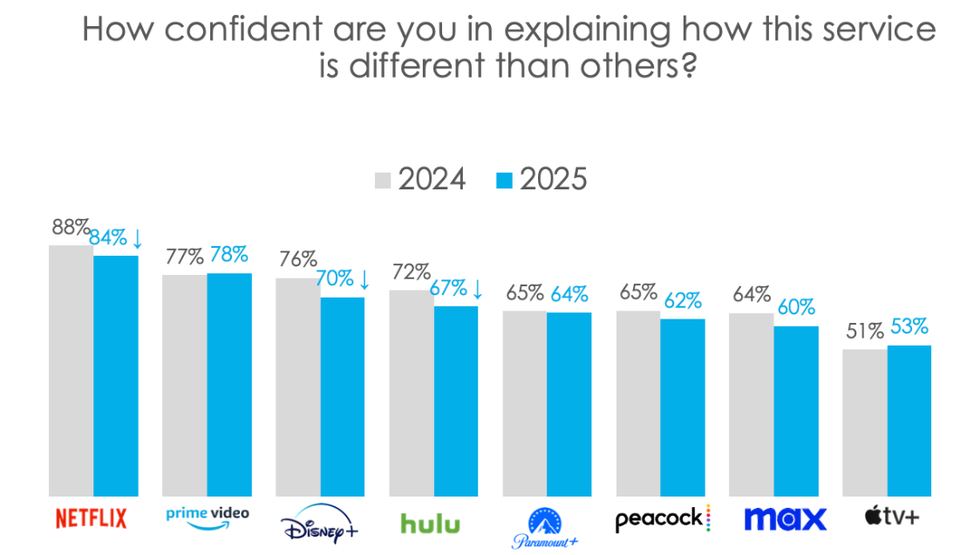
Click graphs to expand.
For years, one of the hallmarks of consumer practices was to sign up for new streamers specifically for an individual show. However, as streamers are increasingly looking ot generate more broadly appealing titles, this practice is becoming less regular. In 2023, 41% of people said they did so, but the number dropped to 39% in 2024. So far in 2025, the number has fallen to 37%.
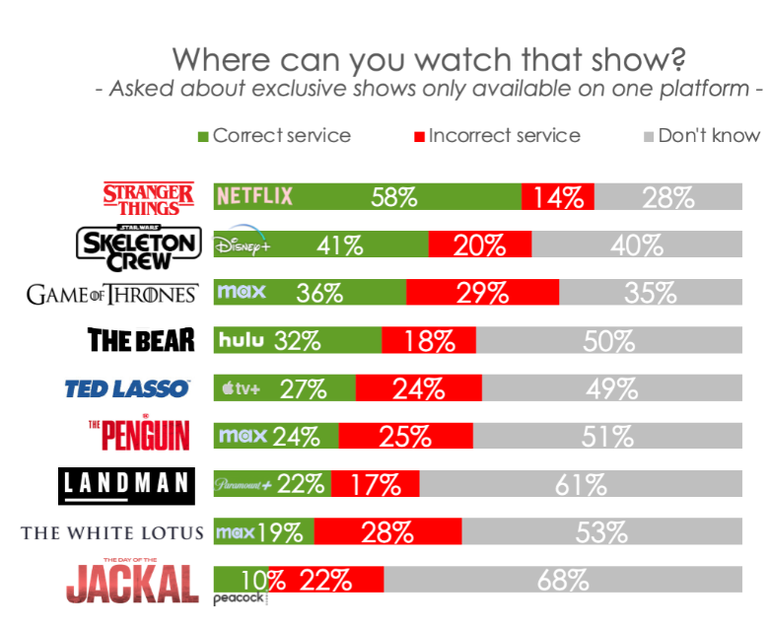
Hub also looked at which titles streaming customers were most able to identify as belonging to a specific streamer. “Stranger Things,” for example, is recognized as a Netflix title by 58% of consumers. But less than half of respondents to Hub’s survey knew where signature shows like “Game of Thrones,” “The Bear,” or “Ted Lasso” are streaming.
“Services that lean into broad-appeal scripted programs may not be enough for viewers who struggle to identify what makes services distinct from one another,” Hub senior consultant Jason Platt Zolov said. “Emphasizing more brand-defining features and value drivers beyond just exclusive originals could have more upside for streamers looking to improve viewer loyalty.”
Paradoxically, some streamers have made the problem worse in the name of making access easier for customers. Disney+, for example, began carrying the vast majority of content found on Hulu in order to reduce the friction of switching between apps for Disney Bundle subscribers. But it’s likely that the move is also making it more confusing for viewers to know which title originated on which streamer.
One major differentiator among streamers can be live sports. Netflix’s stream of live NFL games on Christmas Day 2024 was a win for the service in this regard, as the inclusion of live football on that service made 49% of respondents say they were at least a little more likely to sign up for or keep their Netflix subscription. Having differentiated content is key to keeping customers engaged (and subscribed) to a service; otherwise, they don’t have an incentive to stay signed up and are at constant risk of canceling and spending their streaming dollars somewhere else.

Disney+
Disney+ is a video streaming service with over 13,000 series and films from Disney, Pixar, Marvel, Star Wars, National Geographic, The Muppets, and more. It is available in 61 countries and 21 languages. It is notable for its popular original series like “The Mandalorian,” “Ms. Marvel,” “Loki,” “Obi-Wan Kenobi,” and “Andor.”