Survey: Streamer Stacking Continues to Fall as Free Service Viewership Rises; Will Platforms Lower Prices?
Survey: Streamer Stacking Continues to Fall as Free Service Viewership Rises; Will Platforms Lower Prices?
Research by Omdia offers further proof that streaming customers are turning increasingly to ad-supported streaming services as budgets tighten.


There’s been a huge amount of coverage of streaming price increases in recent months, for the simple reason that almost every top subscription video-on-demand (SVOD) service raised its prices on at least one plan during the year. Netflix, Disney+, Hulu, Apple TV+, Max, Paramount+, and Peacock all hiked subscription rates on one or more tiers, and new data released by global research firm Omdia indicates customers are responding by ditching some streamers from their stack.
- Omdia’s data shows the number of SVOD subscriptions per household fell from 3.5 to under 3 between April and November 2023.
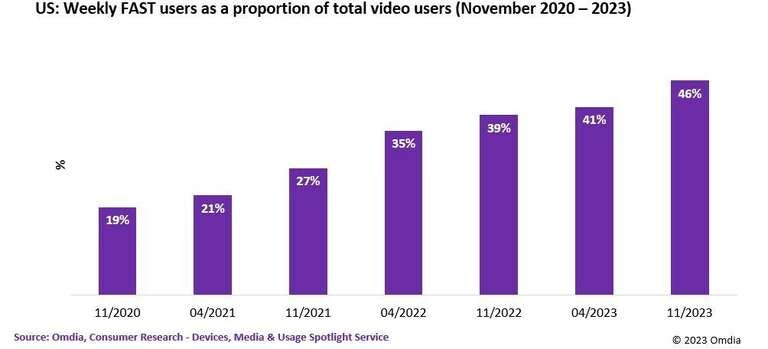
- The amount of free streaming is continuing to increase, as Omdia found weekly free ad-supported TV (FAST) viewers rose to 46% of the total TV audience.
- Despite increasing evidence that customers are growing dissatisfied with streaming costs, audiences shouldn’t expect prices to drop.
Gaining FAST
The research recently made public by Omdia shows that as of November 2023, the average household in the United States stacks fewer than three SVOD services. That’s a drop of nearly 15% between April and November of last year when Omdia found the average household paid for 3.5 streamers each.
To fill in the viewing void left by these channels, audiences are increasingly turning to free ad-supported TV (FAST) channels that stream on platforms like Pluto TV, The Roku Channel, and Tubi. Omdia found that in November, 46% of total TV viewers watched a FAST channel at least once per week.
“After over half a decade of steady growth, we’re observing a shift in how paid video services are consumed,” said Omdia’s senior research director Maria Rua Aguete. “The traditional model of stacking multiple paid services is losing ground. This is partly driven by the increasing popularity of free ad-supported television (FAST) channels, which are becoming a preferred choice for supplementary viewing.”
Subscription video streaming is, by and large, not a profitable industry yet. Only Netflix turns a regular profit from streaming as of now, which is why Disney, Warner Bros. Discovery, and other media companies have been so enthusiastic in raising prices of late. They’ve got to demonstrate to their shareholders that they can make streaming profitable, but customers are making it clear there’s a limit to how much they can pay in total for their streaming services.
Will Streamers Lower Prices in Response to Increased Affinity for Ad-Supported Streaming?

The decreased willingness of customers to keep three or more paid streaming subscriptions in their stack permanently will sadly not lead to lower prices on ad-free streaming plans for customers. Streaming providers are too focused on boosting profits to pull back ad-free streaming prices now, especially when price hikes are having the intended effect of driving more subscribers to cheaper ad-supported plans.
Data released by Antenna last week indicates that in November of 2023, signups to ad-supported plans of paid streaming services outnumbered ad-free signups for the first time. Such plans allow providers to collect both subscription revenue and money from advertisers and thus are worth more than ad-free plans are despite the fact that many ad-free streaming tiers are often twice as expensive as plans with commercials, or more.
Warner Bros. Discovery’s CEO David Zaslav said in September that his company saw “very minimal” churn thanks to price increases on Max. Most customers have become used to cycling between services, signing up to watch one show or movie, and then canceling their subscription before being billed again in order to keep costs down.
Customers may see streaming services continue to add improved features to their ad plans, such as Netflix’s decision to allow its Standard with Ads subscribers to download content for offline viewing. But price decreases likely aren’t in any streamer’s future, even as stacking falls and time spent on FAST channels increases for American subscribers.

HBO Max
HBO Max is a subscription video streaming service that gives access to the full HBO library and exclusive Max Originals. There are hubs for content from TLC, HGTV, Food Network, Discovery, TCM, Cartoon Network, Travel Channel, ID, and more. Watch hit series like “The Last of Us,” “House of the Dragon,” “Succession,” “Curb Your Enthusiasm,” and more. Within HBO Max, B/R Sports allows users to watch live NBA, MLB, NHL, March Madness, and NASCAR events.