Survey: Linear TV Losing Viewers From Every Age Group, but Broadcaster-Led Streamers See 26% Increase in Usage
Survey: Linear TV Losing Viewers From Every Age Group, but Broadcaster-Led Streamers See 26% Increase in Usage

Ampere Analysis has more bad news for linear TV providers. The London-based market research, data, and analytics firm has released a new study regarding the TV habits of internet-using customers, which makes up a large share of the addressable entertainment market worldwide.
Ampere’s data shows that 45% of self-identified internet users say they watch little to no linear TV on a regular day. In 2021, that figure was just 37%. It’s not all younger viewers driving the number down either; 35% of respondents who said they watched no traditional TV were 45 years of age or older.
All segments of the linear viewing audience have seen declines since 2017. But so-called “high linear” viewers who watch more than four hours of broadcast TV per day have seen the biggest dip among internet users; in 2017, over 25% of users claimed to watch that much traditional TV. Now, the number has dropped to 20%.
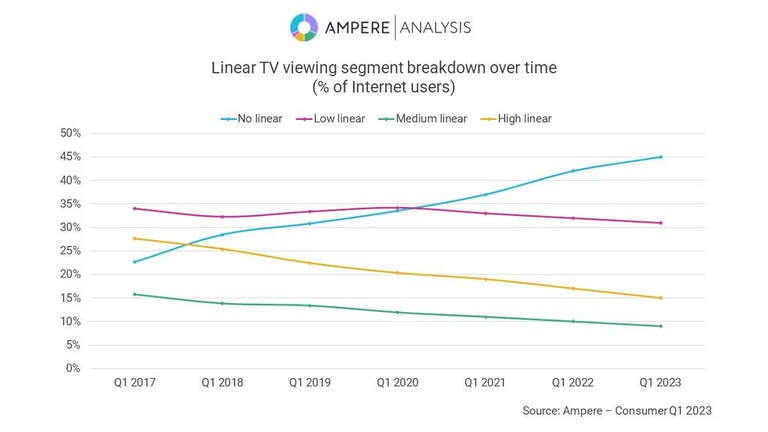
There is one bright spot for traditional TV providers in Ampere’s data. The number of users who watch two hours of linear TV or less per day (“low linear” users) has remained fairly steady, seeing only modest declines in the past six years. This suggests that users still tune in for breaking news, sports, or other major live events.
Ampere’s numbers show no similar decline for streaming video. The number of internet users who say they stream four or more hours of video-on-demand every day has increased from 58% in 2021 to 62% in 2023. This gives broadcasters an opportunity to transition to the streaming format; some of their live content is obviously still desirable, but they have to meet viewers where they are. Some providers are doing so, as engagement with broadcast-led video services has increased 26% since the first quarter of this year.
“At first glance, the decline in linear TV viewing looks to be a worrying trend for broadcasters as their traditional audience begins to drift away,” Ampere research director Minal Modha said. “However, as the increased engagement with broadcast-led video services shows, if the linear channels can continue to adapt and provide a strong [streaming] offering for audiences switching from scheduled TV channels, they have an opportunity to retain them, albeit on a different medium.”
That could be a good sign for Paramount+ and Peacock, which offer livestreams of local CBS and NBC affiliates respectively on their highest-priced tiers. This allows viewers of those channels to watch local news and sports without the need for a pay-TV subscription, and they don’t have to worry about carriage disputes causing the channels to go dark with little-to-no warning.
That’s a problem cable and satellite customers are dealing with more and more nowadays. DIRECTV became the latest multi-channel video provider to descend into a carriage dispute, disagreeing with Nexstar over the proper fees for that company’s 200+ local stations around the country. Nexstar-owned channels in more than 100 markets in the United States have gone dark, and there’s currently no word on when they’ll be available again.
Ampere’s new survey could be good news for Disney, which is exploring the best way to make the ESPN family of channels available as a streaming product without a cable subscription. It shows that linear viewers who spend time watching ESPN daily on pay TV will likely follow the channel to streaming if offered the chance,