Report: Streaming Services Released 60% More Original Titles in 2022, But Can This Pace Continue in 2023?
Report: Streaming Services Released 60% More Original Titles in 2022, But Can This Pace Continue in 2023?


The COVID-19 pandemic hit the entertainment industry hard with production delays and show cancelations, some of which had already been renewed. The top streamers, though, recovered in 2022, according to new data from Omdia’s Digital Content & Channels Intelligence Service. However, it’s uncertain if these services can — or even want to — keep up their recent pace of original content in the coming year.
In total, Netflix, Prime Video, Apple TV+, Disney+, HBO Max, Hulu, Paramount+, and Peacock released 1,752 titles and 4,878 hours of first-run original content, a 60% and an 87% increase in titles and hours, year-over-year.
Netflix was the most active creator in 2022, releasing 3,531 hours and 935 titles, more than half of which were produced outside of the United States. Omdia estimates that Netflix has released more than 14,000 hours of original productions since the debut of “Lilyhammer” in 2012, the company’s first original series.
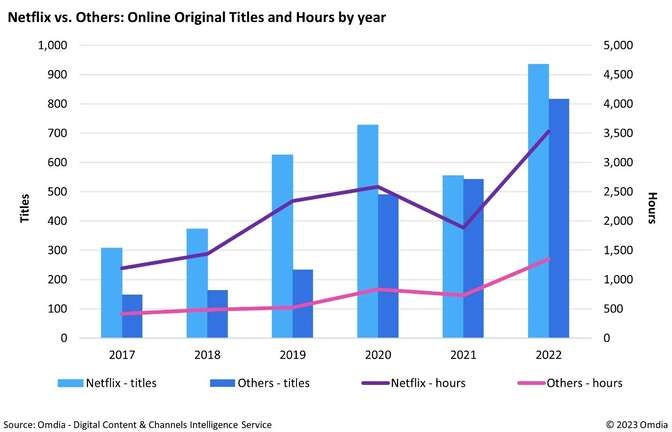
And for the third straight year, Amazon debuted more foreign-produced movies on Prime Video than domestic ones. Amazon’s 2022 crop of 203 titles and 764 hours of first-run original programming represented its greatest annual totals ever.
Last year, other streamers released 614 original titles, a 44% increase from the previous year, most of which originated in the United States. Over 30% of those 614 properties were made by the Warner Bros. Discovery service HBO Max, with Disney+ providing 19%. All streamers were able to ramp production back up after sets shutdown in 2020 and 2021 due to COVID concerns.
“The increase in original production is mainly driven by two factors: new productions delayed by the COVID pandemic finally arriving online, and the continuing international rollout of studio-backed [direct-to-consumer] services such as Disney+, HBO Max, and Paramount+,” Omdia Tim Westcott said.
However, there are several factors that could prevent this return to pre-pandemic content creation — or at the very least keep the number of original shows being produced steady. One is that in the upcoming year, many streamers have announced that they will slow their spending on original content on a year-over-year basis. According to a January report, content spending will only increase by 2% in 2023, down from the 6% growth seen in 2022.
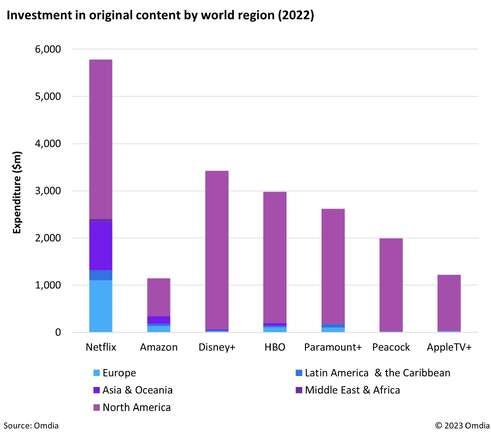
In the coming year, Netflix plans to keep spending money on brand-new films and television programs at rates seen in recent years. In 2021 and 2022, Netflix spent $17 billion on programming, and it plans to spend at least that much in 2023. Even though that number is still mind-bogglingly high, it has basically stayed the same for three years, which has led Netflix to become pickier about the movies and series that it chooses to invest in.
This, of course, makes sense. As media companies cut back on spending to deal with skyrocketing losses from developing streaming platforms and slower-than-expected subscriber growth, streamers are facing tougher circumstances. Therefore, they’re being more contentious about where they spend their money, hoping to get the biggest bang for their buck.
“What we have to do is be better and better at getting more impact per billion dollars spent than anyone else,” co-CEO Ted Sarandos recently said during the company’s recent earnings call. “And that’s how we’re focusing on it.”
Along with media companies cutting back on spending, streamers are getting pressure from shareholders to “reduce their expenditure and stem the losses of their strategic move into streaming,” according to Westcott.
Disney reported fourth-quarter streaming losses of over $1 billion, nearly doubling year-over-year, and Peacock reported fourth-quarter streaming losses of $978 million. WBD also reported streaming losses of $217 million in the fourth quarter, but its aggressive cost-cutting measures resulted in a marked improvement over the $600 million it reported in the segment during the previous quarter.
In the coming months, more streamers will likely take a page from WBD’s playbook and cut underperforming and costly shows in an effort to shore up their bottom lines. This has already begun to play out as Netflix, AMC Networks, and STARZ have all made the difficult decisions to cancel several shows over the past year in an effort to cut costs. While cancelations are an inherent part of the TV industry, as the year progresses, most streamers are likely to pare back their content offerings even further as they cancel more borderline shows and produce fewer originals.
Lastly, the recovery could also be impacted by a looming Writer’s Guild of America strike, possibly akin to the 2007-08 WGA strike, which had a significant effect on the industry for years. A possible strike would result in the shutdown of most productions. Viewers may not immediately notice any disruptions because series are produced months or even years before they broadcast, but depending on how long a potential strike lasts, the development pipeline will eventually slow down, resulting in fewer new projects coming to TV and streamers.
Moreover, a new deal between the writers and streaming services will likely result in a pay increase for writers, which means production budgets would inevitably rise. This could result in fewer new programs being greenlit or renewed. It goes without saying that the streaming services won’t be happy to pay anyone more than they already have to, so it’s possible that they’ll scale back on the number of projects they take on moving forward to make up for higher line items.
All of this will make it more difficult for streamers to release original content at the breakneck pace from 2022. The results may not be felt right away, as plenty of content produced prior to 2023 is still slated to air this year, but the number of cancellations and the reduced number of new shows ordered will be a good indication of how streamers are responding to these difficult times.
-
Netflix
Netflix is a leading subscription-based video streaming service that offers on-demand access to an extensive library of over 3,000 movies, 2,000+ TV shows, and a growing collection of acclaimed Netflix originals. Renowned for producing groundbreaking content, Netflix has become a cultural powerhouse with hit originals like “Stranger Things,” “Wednesday,” “Squid Game,” “The Crown,” “Tiger King,” “Bridgerton,” “The Witcher,” and “Black Mirror.”
-
HBO Max
HBO Max is a subscription video streaming service that gives access to the full HBO library and exclusive Max Originals. There are hubs for content from TLC, HGTV, Food Network, Discovery, TCM, Cartoon Network, Travel Channel, ID, and more. Watch hit series like “The Last of Us,” “House of the Dragon,” “Succession,” “Curb Your Enthusiasm,” and more. Within HBO Max, B/R Sports allows users to watch live NBA, MLB, NHL, March Madness, and NASCAR events.

