How will streamers keep young subscribers in the fold?
How will streamers keep young subscribers in the fold?
A new study from Ampere Analysis creates room for discussion about what streamers can do to keep young viewers engaged.

Despite the popularity of platforms like TikTok among young viewers, streaming is still a highly popular medium of video entertainment with this age group. Data published by Nielsen last year found that viewers aged 18 to 24 get more than 60% of their TV from streaming services, and because younger viewers typically have more disposable income, they are a highly valuable demographic to have the loyalty of for streaming services. New data from Ampere Analysis has insights on what streamers can do to ensure loyalty, and serves as a jumping off point for a wider discussion of the issue.
Key Details:
- Cycling champions: Almost 60% of viewers aged 18 to 34 report canceling a streamer, then resubscribing to it later.
- Engagement gap: Only 52% of this age group return to over-the-top streamers daily.
- Not playing around: Younger audiences are looking for value and content, not simply gimmicks like games.
The data from Ampere Analysis shows that, on balance, the needs of younger viewers aren’t that different from those of older demographics when it comes to streaming services. Despite the cynical protestations of older generations, the needs and wants of young audiences are anything but frivolous.
Data from Ampere Analysis confirms as much. According to a recent study fielded by Ampere, viewers aged 18 to 34 who are at risk of canceling a streaming service within the next 12 months are motivated by pretty standard features. Forty-one percent say they want to be able to watch a given service across a wide range of devices, and 40% cite access to multiple episodes and seasons of a TV series as a motivating factor to sign up.
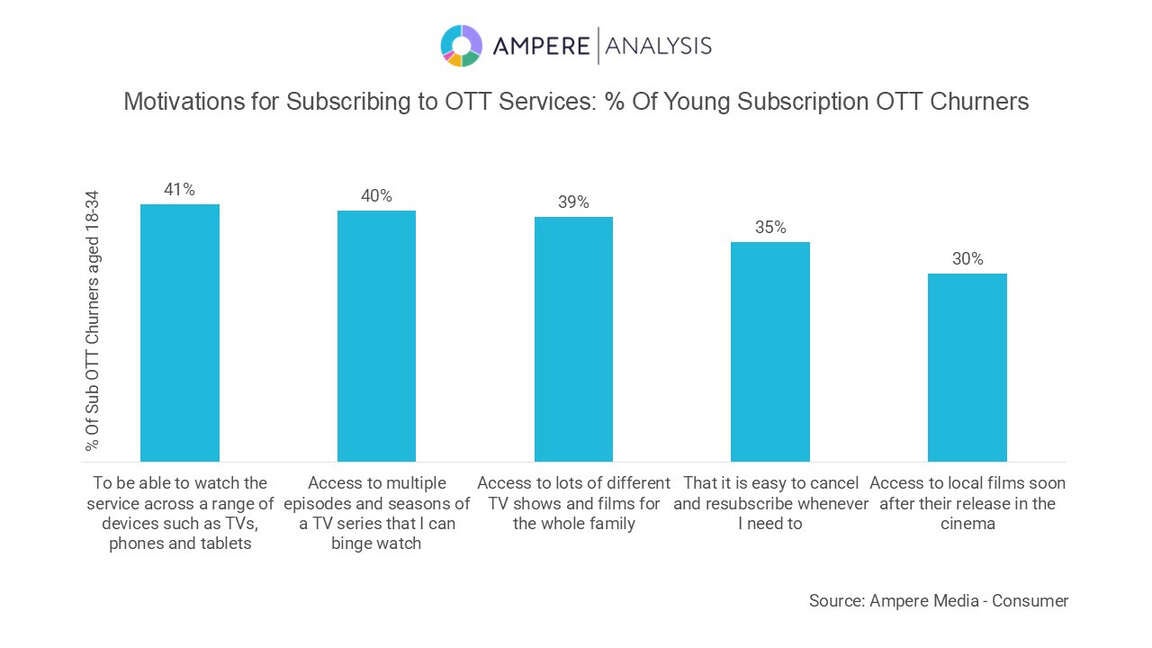
Click chart to expand.
Instead of simply canceling streaming services and walking away from them when the cost gets too high, younger viewers are more likely to cycle; cancel their subscription, then re-subscribe later when a piece of content they want to stream comes back to the platform. Fifty-eight percent of viewers aged 18 to 34 say they engage in this behavior, as opposed to 40% of people on average around the globe.
If that number wasn’t enough to indicate that streamers have a loyalty problem, Ampere’s study has further data in that regard. It found that 85% of viewers aged 18 to 34 use a social video service daily, but only 52% return to subscription streaming services every day. That points to a clear engagement gap that streamers have to solve.
So, how will they accomplish this? Consolidation may be one answer; having multiple different types of content available was a high priority for younger viewers who responded to Ampere’s survey, as shown above. Having streaming services come together in soft or hard bundles can accomplish this goal, combining streaming libraries and sports rights on fewer platforms to help promote engagement.
A survey released by Antenna in 2024 showed that bundles can reduce churn rates dramatically, and younger viewers are just as eager to access more content while saving money as anyone else. More consolidation and bundling will occur in the coming years as the companies that can actually make streaming profitable rise to the top of the industry, while others fall away.
Turning back the clock to find content might be a wise decision, as well. A study from Tubi, which was released earlier this year, found that 87% of Gen Z respondents said streamers should make older content available to them, as opposed to just new releases. Most streamers have catalogs that include older shows and movies, but they may want to make a greater effort in leaning into the feelings of nostalgia generated by these titles, or in putting them in front of customers who have never heard of them before.
There may be bad news for Netflix buried in Antenna’s figures, specifically when it comes to the streamer’s mobile games. Gimmicks such as these may not be important to younger subscribers, and likely aren’t doing much to keep them engaged, as Ampere’s study doesn’t list such features as a key factor in motivating the choices of young subscribers. Netflix doesn’t release metrics on the performance of its games often, but in 2022, data showed that less than 1% of subscribers played them.
To me, the data from Ampere shows that younger viewers simply aren’t that different from anyone else when it comes to what they want from streaming services. They want to feel that a streamer is delivering good value for the price they pay, and that they can watch a wide range of content while using a given platform. These demands seem relatively simple, but there’s a reason no streamer has cracked the formula yet, and each of them will have to keep working to keep younger viewers engaged for the long haul.

Netflix
Netflix is a leading subscription-based video streaming service that offers on-demand access to an extensive library of over 3,000 movies, 2,000+ TV shows, and a growing collection of acclaimed Netflix originals. Renowned for producing groundbreaking content, Netflix has become a cultural powerhouse with hit originals like “Stranger Things,” “Wednesday,” “Squid Game,” “The Crown,” “Tiger King,” “Bridgerton,” “The Witcher,” and “Black Mirror.”