Americans and Brits spend 11 hours per day consuming media
Americans and Brits spend 11 hours per day consuming media
New data from Ampere Analysis sheds light not only on how much media people are using, but what kinds specifically.

As it turns out, time spent listening to Spotify or watching YouTube while doing chores around the house can really add up during a day. That was a key finding of a new study from Ampere Analysis, which shows that American and British consumers ingest roughly 11 cumulative hours of media each day. But what specifically are people doing when they consume media, and what kinds are they enjoying most?
Key Details:
- Almost all day: American and British users spend 11 hours per day consuming media.
- Video first: Streaming services and YouTube combine to account for over one quarter of this time.
- Hidden message?: The data could point to the futility of streaming services trying to add more features from creator video sites.
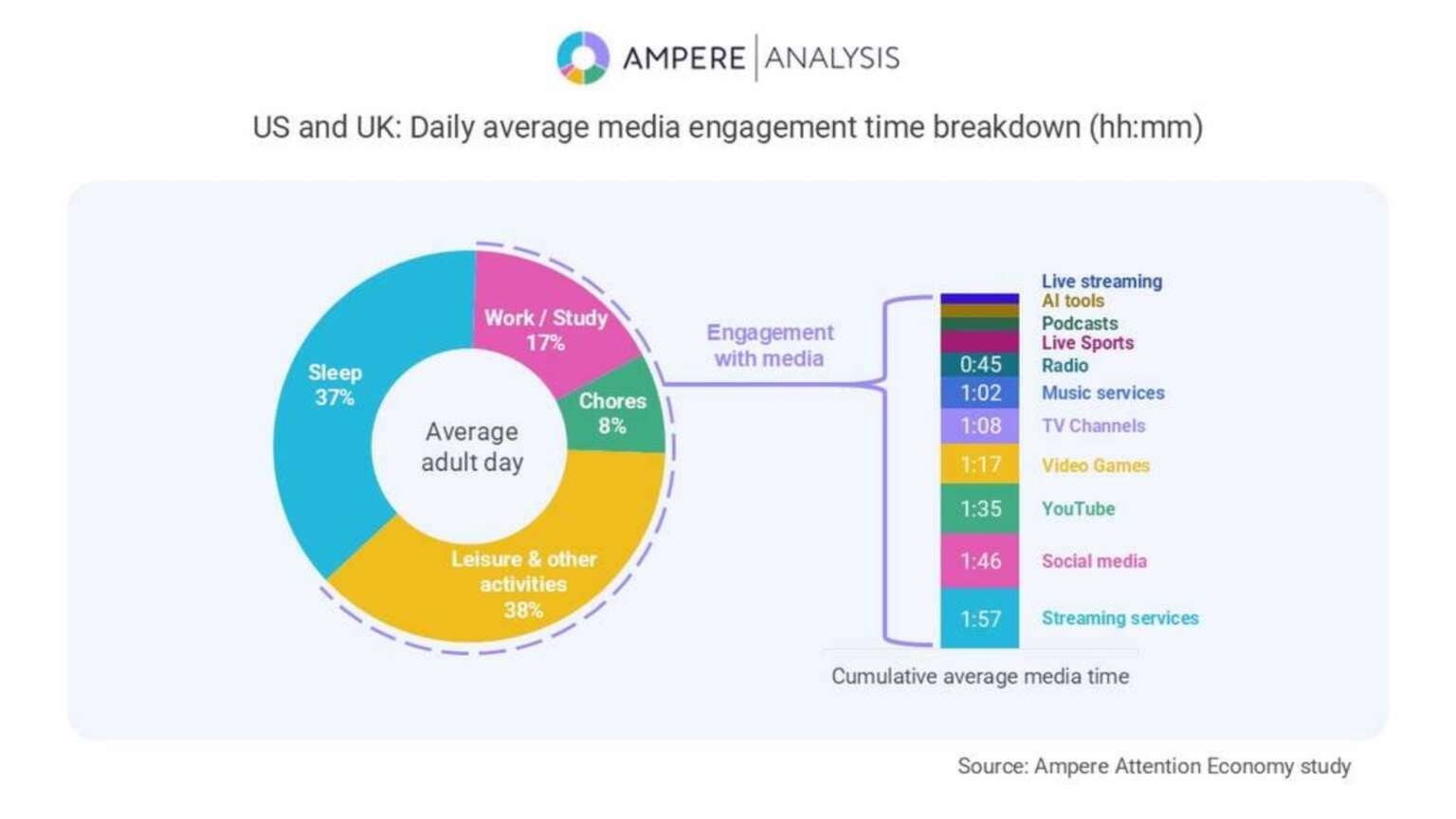
As Ampere discovered, Americans spend 11 hours of every day consuming media products, including overlapping activities such as using a phone while watching TV or streaming. Engagement with media can span the average person’s entire waking day, including leisure and other activities, chores, and work and study time.
Overall, Ampere found that viewers spent 1 hour and 57 minutes with streaming services during the day, and another hour and 35 minutes with YouTube. That adds up to more than 3.5 hours each day spent with video services, and the 11 hours of total engagement also includes 1 hour and 8 minutes of time spent viewing TV channels.
Click image to expand to full size.
Demand for different media products can vary by age. Gen Alpha spends the most time each day with YouTube and gaming, while Gen X and Baby Boomers are more likely to watch TV channels, live sports, and streaming services. Streamers are mostly used for relaxation and immersion, and YouTube for discovery and lifting users’ moods.
“Today’s consumers have more varied media diets than ever before, selecting from an expanding menu of media depending on what they want in the moment,” Ampere research manager Sam Nursall said. “Whether they’re looking to relax, discover something new or simply fill spare time, each medium serves a different purpose. That’s today’s attention economy. For advertisers and broadcasters, understanding those different moments is just as important as understanding the audience itself.”
The data from Ampere may give some streaming executives pause as they spend time, effort, and money to transform their platforms to resemble creator video services. Disney+, HBO Max, Netflix, Paramount+, Peacock, and other streaming services now offer a vertical video scroll, and Netflix has imported video podcasts and other creator content in a bid to pry viewers away from platforms like YouTube and TikTok.
But as Ampere’s latest study shows, audiences think of platforms like YouTube and Netflix as serving different needs. Spending a huge amount of resources trying to combine their most popular features on the same platform may not be necessary. It’s entirely possible that streaming services would be better served by leaning further into the things that viewers prize them for most: providing a place to relax and be immersed in entertainment.

Netflix
Netflix is a leading subscription-based video streaming service that offers on-demand access to an extensive library of over 3,000 movies, 2,000+ TV shows, and a growing collection of acclaimed Netflix originals. Renowned for producing groundbreaking content, Netflix has become a cultural powerhouse with hit originals like “Stranger Things,” “Wednesday,” “Squid Game,” “The Crown,” “Tiger King,” “Bridgerton,” “The Witcher,” and “Black Mirror.”