MLB’s regional rights are worth $1.6 billion annually
MLB’s regional rights are worth $1.6 billion annually
New data from Ampere Analysis shows why teams have been so hesitant to join an in-market streaming service, but there is hope for fans.

Major League Baseball may not be the hot property it once was for American broadcasters in the middle of the last century, but the league can still draw a healthy audience to marquee matchups on national TV. Because there are 162 games per team per season, however, teams play the vast majority of their games each season on regional sports networks (RSNs) or other regional-only outlets. MLB has its sights set on launching a streaming platform with most, if not all, of its teams to offer a centralized hub for in-market games, and new data from Ampere Analysis on the value of MLB regional rights highlights the challenges of creating such a platform, but also offers hope.
Key Details:
- Chunk of change: MLB’s local rights are worth $1.6 billion per season by themselves.
- Slice of the pie: The Dodgers and Yankees account for 23% of that revenue, presenting a challenge to a combined regional streaming platform.
- Things change: A new CBA could increase revenue sharing between teams, smoothing the path to a combined regional streamer.
MLB local rights were once part of the bedrock of traditional regional sports networks (RSNs), but the decline in cable viewership overall has hit RSN programmers hard. Over the past four years, 13 of MLB’s 30 clubs have lost their RSN partner, and many of the affected teams now have their local games distributed by MLB itself.
That has contributed to the value of MLB local rights, according to Ampere Analysis. It pegs the value of MLB local rights in 2026 at $1.6 billion, accounting for 43% of the league’s overall broadcasting revenue. National MLB rights account for another $2.1 billion annually.
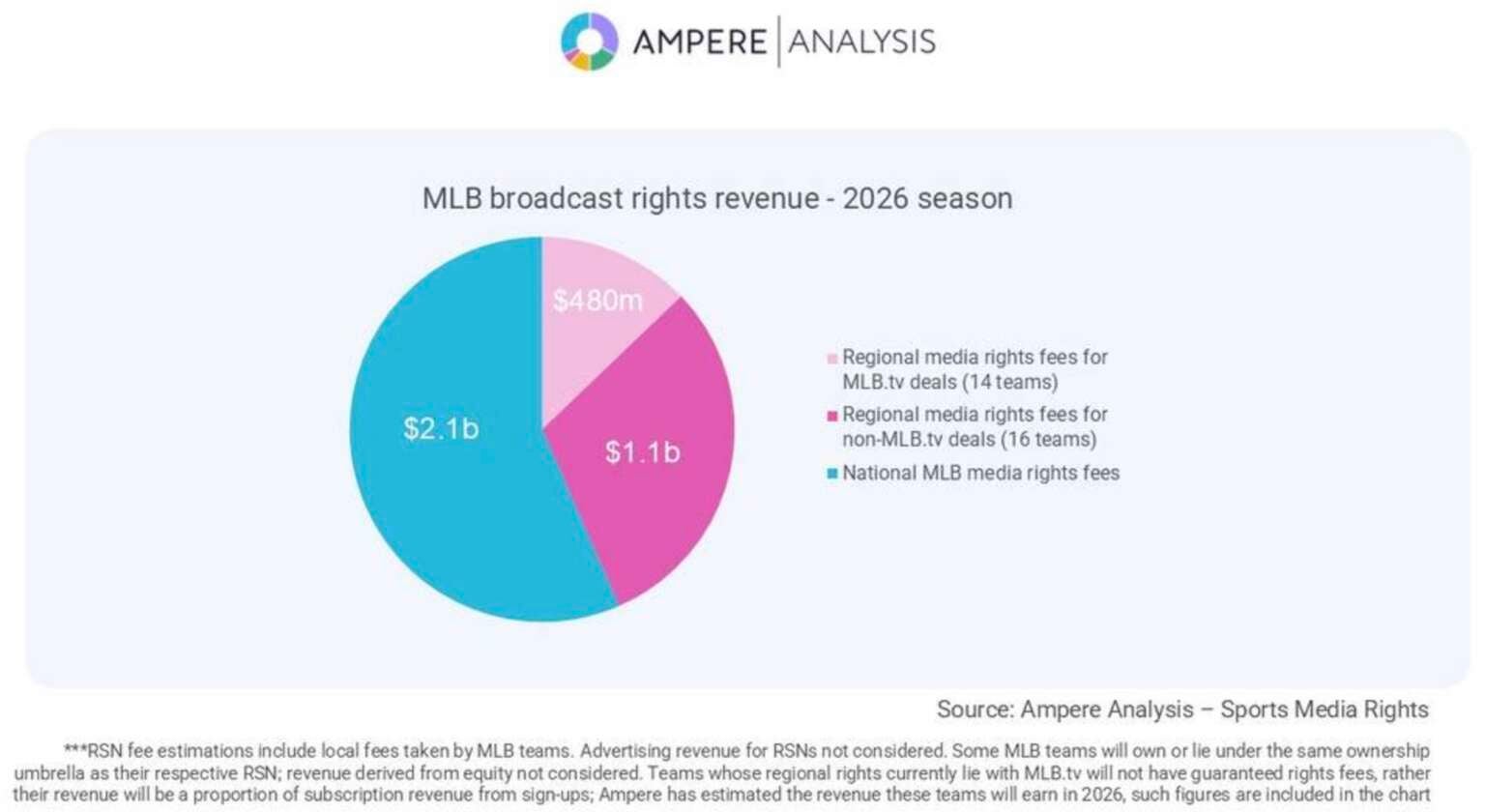
Click chart to expand.
The value of MLB’s regional rights highlights the biggest problem the league has in trying to launch a single streaming platform that will distribute each team’s local rights in their respective markets. Such a service is in the league's plans, but some teams make far more from their local rights deals than others; Ampere measures that the Los Angeles Dodgers and New York Yankees alone account for 23% of league-wide local rights revenues.
Such clubs have little incentive to join a league-run platform that may pay far less than they’re currently making for their local rights. But there may be hope for fans of such teams who have cut the cord but still want to watch live in-market games. MLB’s current collective bargaining agreement with its players expires at the end of this year, and if more revenue sharing between clubs is introduced in the next CBA, it could reduce the revenue gap between markets.
MLB rights certainly aren’t as lucrative as the most popular sport in the U.S., the NFL; that league attracts around $10 billion per year for its TV rights. But Ampere’s data shows that MLB’s local rights are still a hot property, highlighting the challenges the league is facing as it tries to sort out in-market distribution in a way that makes sense for clubs and fans.

MLB.TV
MLB.TV is the official streaming service of Major League Baseball. You can see every out-of-market game live or on-demand and choose home or away TV and radio feeds. The app allows fans to watch up to four games simultaneously on the same screen through its Multi-view feature. MLB.TV can be added to your Sling TV or Prime Video subscription.