Size of streaming price increases is shrinking
Size of streaming price increases is shrinking
Prices are still going up, but streamers like Disney+ and Netflix are at least decreasing the incriments they’re raising rates by.


Streaming price increases are seemingly impossible to stop. In the past two weeks alone, two streamers revealed they were upping their subscription rates: ESPN Unlimited and Peacock, which hiked rates by (link: https://thestreamable.com/peacock-price-increases-2026 text: as much as $3 per month. But new data from Ampere Analysis does offer some relief for customers: price increases may be continuing unabated, but the size of each increase at top streamers like Disney+, Netflix, and Prime Video is shrinking.
Key Details:
- Getting smaller: Price increase increments at top streamers are getting smaller overall.
- Exception to the rule: Ad-free tiers are seeing the largest price increases.
- Unlucky: Western Europe has seen the largest average price increases over the past three years.
New data from Ampere Analysis shows that average price increases across Disney+, Netflix, and Prime Video have fallen from 24% of the previous subscription price in 2023-24 to 14% in 2025-26. Of course, part of the reason for that decline is that base prices are rising; this is reflected in the fact that average price increases have declined more modestly in dollar terms, from $1.67 per increase to $1.54.
Ad-free customers are bearing the brunt of price increases. Ad-free tiers have seen bigger increases over the past three years, averaging $1.62 per increase versus $1.21 for ad-supported tiers. Between August 2025 and July 2026, the average price difference between ad-supported and ad-free plans had grown to $5.35. Ad plans can generate significantly more revenue than ad-free tiers, and streamers are heavily incentivized to drive new subscriptions to such plans.
Disney+ has seen the clearest shift towards more modest price increases. Between 2023 and 2024, the streamer’s average increase was $1.86, but in 2025-26 it fell to $1.45. Netflix’s price increase rates have remained broadly stable over the past three years.
American viewers may think they’ve been grappling with the worst of price increases, but Western European audiences have had it even worse. Increases over the past three years have averaged $1.86 each in that region, compared to $1.70 in the U.S. Central and Eastern Europe have seen the third-largest increases on average over the same period.
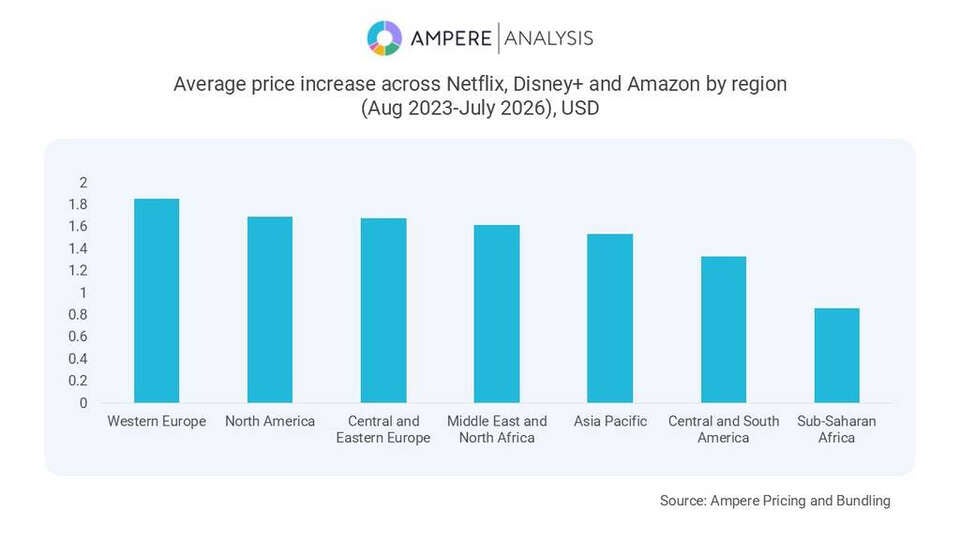
Click chart to expand.
“The decline in price increases comes as streamers diversify how they monetize their audiences,” Ampere Analysis research manager Jaanika Juntson said. “Advertising is an increasingly important revenue stream, reducing reliance on subscription pricing alone, while password-sharing crackdowns allow streamers to generate more value from existing audiences through extra member slots. As streaming businesses mature, revenue growth is becoming less reliant on price increases, while intense competition is also making streamers increasingly mindful of how they are positioned against rivals.”

Prime Video
Prime Video is a subscription video streaming service that includes on-demand access to 10,000+ movies, TV shows, and Prime Originals like “The Lord of the Rings: The Rings of Power,” “Jack Ryan,” “The Marvelous Mrs. Maisel,” “The Boys,” and more. Subscribers can also add third-party services like Max, Showtime, STARZ, and dozens more with Prime Video Channels. Prime Video also offers exclusive live access to NFL Thursday Night Football.