What’s in a name? A brief trip through puzzling streaming names
What’s in a name? A brief trip through puzzling streaming names
From confusing names to abundant +s to all-caps screaming and more, streaming names can leave a lot to be desired.


When I first cut the cord around 2015, the options for live TV streaming were nothing like they are today. Back then, it was really just Sling TV and the oddly named PlayStation Vue for live TV — outside of on-demand services like Netflix, that was about it. And Vue, despite being a solid service at the time, always raised the same question: “Do I need a PlayStation to use it?”
Fast forward to today, and the streaming landscape is full of services with confusing names and constant rebrands. The recent back-and-forth over ESPN’s standalone streamer and Max backpedaling to HBO Max got me thinking: What’s in a name?
Some services, like Vue and Quibi, stumbled partly because people couldn’t figure out what they actually offered. Others, like Max, have dropped recognizable brands only to bring them back again. And we certainly can’t ignore the plethora of “plus” names — Disney+, Paramount+, Hallmark+ — that are everywhere, whether they make sense or not.
So, let’s examine the world of streaming service names: the hits, the flops, the rebrands, and the ones that made you double-take.
Origin story: PlayStation Vue
PlayStation Vue was a streaming service from Sony that launched in 2015 and offered a variety of live channels and on-demand content. It was available as an app across multiple platforms — and, surprisingly, did not actually require a PlayStation.
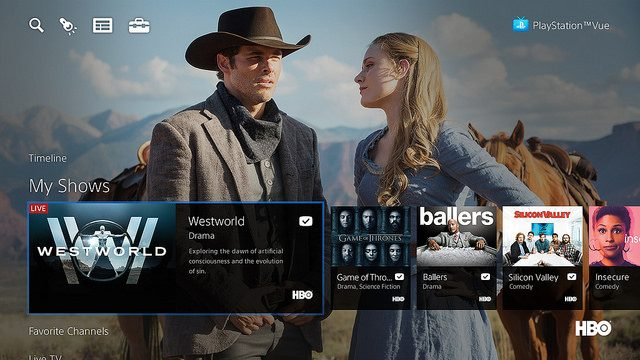
The name was odd, to say the least, given that it ran on everything from Roku to Apple TV. Sony could have easily leaned on its broader brand or simply gone with “Vue” as a standalone title. Instead, the PlayStation branding likely confused potential users and limited its appeal.
It was one of the first — and perhaps most memorable — streaming services with a confusing name, setting the stage for many of the branding misfires we’ve seen since.
The many names of DIRECTV
DIRECTV as we know it today didn’t always have such a simple, one-word name (setting aside the all-caps styling, which we will get to later). When the satellite service launched a live TV streamer in 2016 as DIRECTV NOW, it was designed to compete with Sling, PlayStation Vue, and a handful of other early live streaming platforms.
In 2019, the service was rebranded to AT&T NOW after AT&T, which owned DIRECTV, aimed to unify its branding across all its products and services. However, by dropping the familiar DIRECTV name, the service began to lose traction with customers. To counter this, AT&T renamed it again in 2020 to AT&T TV, hoping to leverage its brand recognition. While this helped somewhat, the association with the AT&T name, much like Sony’s PlayStation branding for Vue, still caused some confusion and didn’t resonate with all viewers.
Then, in 2021, as AT&T spun off parts of its video business into a new joint venture, the service was rebranded again, returning closer to its roots as DIRECTV STREAM. This name stuck for several years and helped consolidate the brand across traditional satellite TV and streaming services.
It wasn’t until 2025 that the streaming service was simplified again, dropping “STREAM” and returning to the straightforward, singular DIRECTV name. We’re hoping this one sticks around for a while, but I wouldn’t be mad if the styling changed at some point!
HBO Max, Max, HBO Max
Even more recent than the latest DIRECTV name change is the decision by the folks at Warner Bros. Discovery to revert back to the original name of its flagship streamer, HBO Max, just two years after streamlining the brand.
After merging with Discovery, Inc., WarnerMedia rolled discovery+ content into HBO Max and renamed the service to just Max, dropping the HBO branding to attract a broader audience. The idea was to signal that the service now offered more than just the iconic HBO programming, which was often seen as skewing toward an older or more prestige-focused demographic.
While the change wasn’t a total disaster, it definitely caused confusion. It took customers a while to realize that Max included both HBO originals and Discovery content — especially since discovery+ never fully disappeared and remained available as a separate service.
Now, two years later, WBD seems to have realized that the rebrand might not have been the smartest move. It’s bringing back the HBO Max name, returning to the brand that gave the service its original identity and recognition.
ESPN’s new streaming service is called ESPN
Although ESPN had publicly used the placeholder name “Flagship” for its long-gestating standalone streamer, that was not the name that the worldwide leader in sports went with when its plans were eventually made public. But since the launch of ESPN+ in 2018, sports fans have been hoping for a true all-in-one destination for ESPN content. While ESPN+ delivered plenty, it never offered the full slate of ESPN programming.
Now, with the upcoming release of the new streaming service, that long-awaited hub is finally arriving — and it’s simply called ESPN.
It’s not the most confusing name in the streaming world, but it’s definitely going to raise some eyebrows. Naming the new service after the existing cable channel — and the already-established apps — could lead to serious confusion. If someone talks about wanting to sign up for ESPN, does that mean they want to include it as one of hundreds of channels in their cable package, or do they only want the narrow offerings of the ESPN streaming service?
To make matters more confusing, ESPN+ is still going to exist, just not as its own streamer. The existing service will now essentially be a channel instead the ESPN streamer. While this is mainly for contractual reasons with leagues that signed broadcast deals specifically with ESPN+, it sure doesn’t make this whole thing less confusing.
An Apple TV doesn’t fall far from the tree
Apple is known for its clean, streamlined apps and products, but the naming convention for its streaming offerings is still a bit tricky. While similar in naming, each product in the streaming space differs just enough to make things confusing.
- Apple TV 4K: Physical streaming hardware device
- Apple TV: App available across multiple platforms to access streaming content
- Apple TV+: The name of the actual premium streaming service
While, like the sleek, streamlined products that the tech company is known for, there is a precision to these names, it does get a bit confusing. For example, if you are a domestic soccer fan, you can watch [MLS League Pass] on Apple TV on your Apple TV 4K, but it isn’t part of Apple TV+. And while as streaming professionals, we use the official names for each of these Apple iterations, most people don’t; they shrink them all down to simply “Apple TV.”
So, for them, it would be, “You can watch [MLS League Pass] on Apple TV on your Apple TV, but it isn’t part of Apple TV.” While we know Apple loves a closed ecosystem, but even this might make Steve Jobs’ head spin.
You get a +, and you get a +, and you get a +
Sometimes a name just makes so much sense that everyone else decides that they want it to be their name, too. There is a certain beauty and simplicity in a name like Disney+. The House of Mouse’s flagship streamer is home to all of the iconic Disney titles that people associate with the brand: “Cinderella,” “Snow White,” “The Little Mermaid,” “Beauty and the Beast,” “Mickey Mouse Clubhouse,” and more, PLUS it has so much more, like Pixar, the Marvel Cinematic Universe, Star Wars, National Geographic, and the more recent additions of content from Hulu and ESPN.
That makes sense, and it communicates something to the user. To be sure, Disney+ was not the first streamer to adopt the “+” nomenclature; that honor belongs to the platform’s corporate sibling ESPN+, which launched in 2018, so at least Disney+ has some familial right to steal the symbol. But from there, it seemingly became the default for lazy and uncreative media execs to simply take the name of their company and slap a + on it.
Now we not only have Disney+ and ESPN+, but also Apple TV+, Paramount+ (and its monstrous sub-tier Paramount+ With SHOWTIME), AMC+, discovery+, BET+, Hallmark+, MGM+, NFL+, CNN+ (R.I.P.), and likely many more that have all bled together into an agglomeration of other non-descript names in my mind.
Again, there is logic in adding the addition sign to your corporate name in order to create your streaming branding, but at some point, there has to be some level of pride that tells you that wantonly stealing a rival’s gimmick is beneath you, right? Based on how derivative and mundane the naming has gotten across the streaming world, I guess the answer is no.
Why are we shouting?
I have always been taught that if you write something in all caps, it communicates to your reader that you are screaming. So it can be jarring, at times, when streaming services insist on shouting their name at you: DIRECTV! STARZ! SHOWTIME!
DIRECTV has always relied on all-caps branding — blame it on the days when satellite had to scream over the din of cable TV options just to be heard — but the latter two in this shouted list specifically chose to holler specifically for their streaming services. Both Starz and Showtime began their lives as premium cable channels, and while those versions of the brands still exist, as they transitioned to this new phase in media consumption, they decided neither to add a + to their names, nor to go the ESPN route and just keep their names the same, but to, somehow even more confusedly, split the difference and go all caps for streaming.
For some reason, the excitement (or corporate pressure) of streaming services is so intense that simply speaking a service’s name is not enough; instead, these names must be bellowed. Of course, I suppose that this is preferable to the whispered discovery+, a service that Warner Bros. Discovery is apparently so timid about promoting that it won’t even capitalize any letters in its name, even the first.
What is in a name?
At its most functional level, a name is used to distinguish someone or something from everything else in the world. A name makes it easier to talk about said thing without getting lost in a sea of confusing, non-descript references. It conveys specificity that allows speakers and listeners to be precise in what they are talking about.
But it also carries meaning, both practical and sentimental. To be effective, a name should either communicate something intrinsic about the thing it is referencing or express some sort of meaning behind it.
Take Peacock for example. While the name doesn’t inherently provide unfamiliar consumers with any information about what can be found on the platform, it harkens back to the beloved, longtime mascot of the platform’s corporate parent, NBC. So, there is not only a branding throughline to the name, but also an emotional one that has been built up over generations.

While the name Hulu doesn’t have the same longevity, it does have its own, somewhat tender meaning. The name comes from the Chinese word 葫芦 (“húlu”), which means gourd. While you might be thinking that it is weird to name your streaming service, in Chinese culture, gourds are associated with holding precious things.
“It had this great sort of symbolism of the holder of precious things, which is the holder of premium content. So that’s why we named it Hulu,” former Hulu CEO Jason Kilar explained.
It also helps that 互录 (“hùlù”) means interactive recording… which is what Hulu essentially was when it became the first service to offer next-day streams of TV episodes that you would otherwise need to record to watch.
When it comes down to it, the name of a streaming service isn’t the thing that is ultimately going to determine its success or failure. That will come from all of the swirling factors like price, library, and ease of use, but there should be something solid about a name. Whether it is emotional or descriptive, there should be something behind the name. The last thing you want the name of your streaming service to communicate is that it is ill-conceived and disposable.
Netflix started as a DVD-delivery system; for those of you not old enough to remember, you would literally go onto the interNET and select what FLICKS you wanted to watch, and they would mail them to you. There is a simple elegance to the name that has clearly served it well. As the streaming world continues to evolve and remake itself with each era of corporate entertainment, here’s hoping for more “Net-Flicks.”
What are your thoughts on all the service names and the confusion they cause? Sound off in the comments and let us know!