Was Netflix’s first-ever baseball broadcast a home run? We review
Was Netflix’s first-ever baseball broadcast a home run? We review
The streamer didn’t hit it out of the park, but it didn’t strike out either.


On Wednesday, Netflix didn’t just dip a toe into covering Major League Baseball, the world’s largest streamer cannonballed in by broadcasting the 2026 Opening Day game between the New York Yankees and San Francisco Giants. While the Bronx Bombers essentially dominated the game from start to finish, winning 7-0, Netflix’s broadcast was equal parts technically solid, occasionally clunky, and surprisingly entertaining in a way that felt close enough to traditional baseball broadcasts to be recognizable and digestible, but unique enough to feel like something special.
Now, before I get too far into this review, in an effort toward full disclosure, I think that it is important for me to admit that due to decades of playing, coaching, and being a fan of the sport, I am an unmitigated sucker for the generational traditions and open-hearted nostalgia of the game. So, I am always predisposed to exposed emotions on Opening Day (even if my beloved Cincinnati Reds have been robbed of their natural and inalienable right to play the first game of the season). So, forgive me for being a bit of a sucker for baseball’s sentimentality; this time of year, I tend to harken back quite regularly to the practically poetic “Moneyball” line that Brad Pitt says as Billy Beane, “How can you not be romantic about baseball?”
How was Netflix’s 2026 Opening Day MLB coverage?
The pregame and postgame shows

Click image to expand.
Netflix’s first baseball broadcast started about an hour before the first pitch was supposed to be thrown (more on that later), but following a stirring two-minute intro from the great Daniel Dae Kim (of Netflix’s “Avatar the Last Airbender”), we were welcomed to Oracle Park by a beautiful drone shot of McCovey Cove before being zoomed into the outfield desk as anchored by former ESPN favorite Elle Duncan.
Kim’s intro rather effectively made the case to sports fans — especially the generally older, change-resistant ones amongst us— that Netflix was a perfect place for the pomp, circumstance, history, and grandeur of America’s pastime, by drawing on the connections between the sport’s timeless drama and Netflix’s penchant for storytelling. While I am still not completely sold on the streamer dropping in to do one-off events like Opening Day and the Home Run Derby, the intro package did get me excited about the possibilities.
Take a look at Netflix’s pregame presentation:


Click images to expand to full size.
However, that excitement was increased tenfold by Duncan’s insightful, playful intro, not only to the broadcast, but to the team joining her at the desk. With a crew of MLB legends, working together for the very first time, Duncan was the brightest spot of the pre and postgame coverage, if not of Netflix’s entire presentation. She was able to underscore the importance of Opening Day with the excitement inherent in a new season, with the fun and silliness that, in my opinion, sports coverage needs to lean more into. She was able to pivot back and forth between serious on-field questions and playful jabs at her colleagues with precision, while never letting her novice analysts get too far afield on their talking points.
That aspect of the shoulder coverage was not always easy, as Duncan was joined by seven-time MVP, the career and single-season home run champ, and should-be Hall of Famer Barry Bonds; three-time MVP and two-time World Series champion Albert Pujols; and four-time Gold Glover and World Series champ Anthony Rizzo.
Being in San Fran, obviously, Giants’ icon and Bay Area native Barry Bonds commanded a lot of attention. And while his reputation for prickliness was certainly well-earned during his playing career, he approached his first-ever broadcasting assignment with a surprising amount of humor and joy. While it did devolve to subtle self-aggrandizing at times, given that it was his first time on the mic and the game was in his hometown, you can excuse arguably the greatest player of all-time for talking about himself a little bit more than was actually necessary.
I was especially a sucker for Bonds waxing poetic about Giants’ legends, his godfather Willie Mays and “Uncle Willie” McCovey. I am naturally sentimental for stuff like that, but like I said, the romance of Opening Day only amplifies my already tender heart. While that was the first time that I teared up during the broadcast, it wasn’t the last. My next set of tears came when Duncan shared Yankees’ manager, Aaron Boone’s, Opening Day tradition of telling his players to text someone who helped them get there.
Former Yankee and Chicago Cub Anthony Rizzo told the story of texting his parents on one special Opening Day in the Bronx, “I’m hitting fourth for the New York Yankees,” and I was done for. While Netflix’s first baseball broadcast was far from perfect, it did do a remarkable job of understanding how special Opening Day is, not only to fans but to the players and coaches as well.
Rizzo, just one season out of the game, brought a surprisingly polished presence to the table and even got off a few well-timed jokes. Pujols, fresh off managing the Dominican Republic in the World Baseball Classic, brought both a player’s and a coach’s perspective to the proceedings. For a first-time pairing, the group of former Big Leaguers did a decent job of rising to the moment, but fortunately, the magic of Opening Day helped gloss over some of the awkwardness that naturally comes from a crew — featuring some broadcasting rookies — who had never worked together before.
The Netflixification of Opening Day
While Duncan was undoubtedly the star of the show in my eyes, she was saddled with some of the most cringe-inducing corporate synergistic heavy lifting I have ever seen in a sports broadcast. This wasn’t just a baseball game — it was a self-sustained content showcase. Duncan did her best to make each of the increasingly odd transitions not only feel natural to the true task at hand, but also to lean into the relative absurdity of drawing a connection between baseball’s Opening Day and the forthcoming Netflix film “Thrash,” that sees people fight for their lives against sharks and other (human and non-human) predators following a massive hurricane.
In one of the funnier moments of the broadcast, Duncan broke Bonds with a crack about whether or not he would have been better off using a certain “Stranger Things” prop against Greg Maddux back in the day.
While I am sure that I missed some of the heavy-handed plugs, here is the list of Netflix properties that were not-so-subtly woven into the one-hour pregame show.
- “Avatar the Last Airbender”: Daniel Dae Kim intro narration
- “Free Bert”: Bert Kreischer was the McCovey Cove correspondent and pregame emcee
- “Little Brother”: John Cena (for some reason) explained baseball’s new ABS system
- “Man on Fire”: Yahya Abdul-Mateen II was in attendance
- “Stranger Things: Tales From '85”: Trailer release teased and a real-life version of Steve’s iconic bat was brought to the desk
- “Thrash”: Unbelievably over-the-top transition and graphic
- “APEX”: They showed a commercial for the upcoming Charlize Theron action movie.
- All things WWE: In addition to Cena, WWE superstar Jey Uso — a SF native and Giants fan — was the honorary game starter.
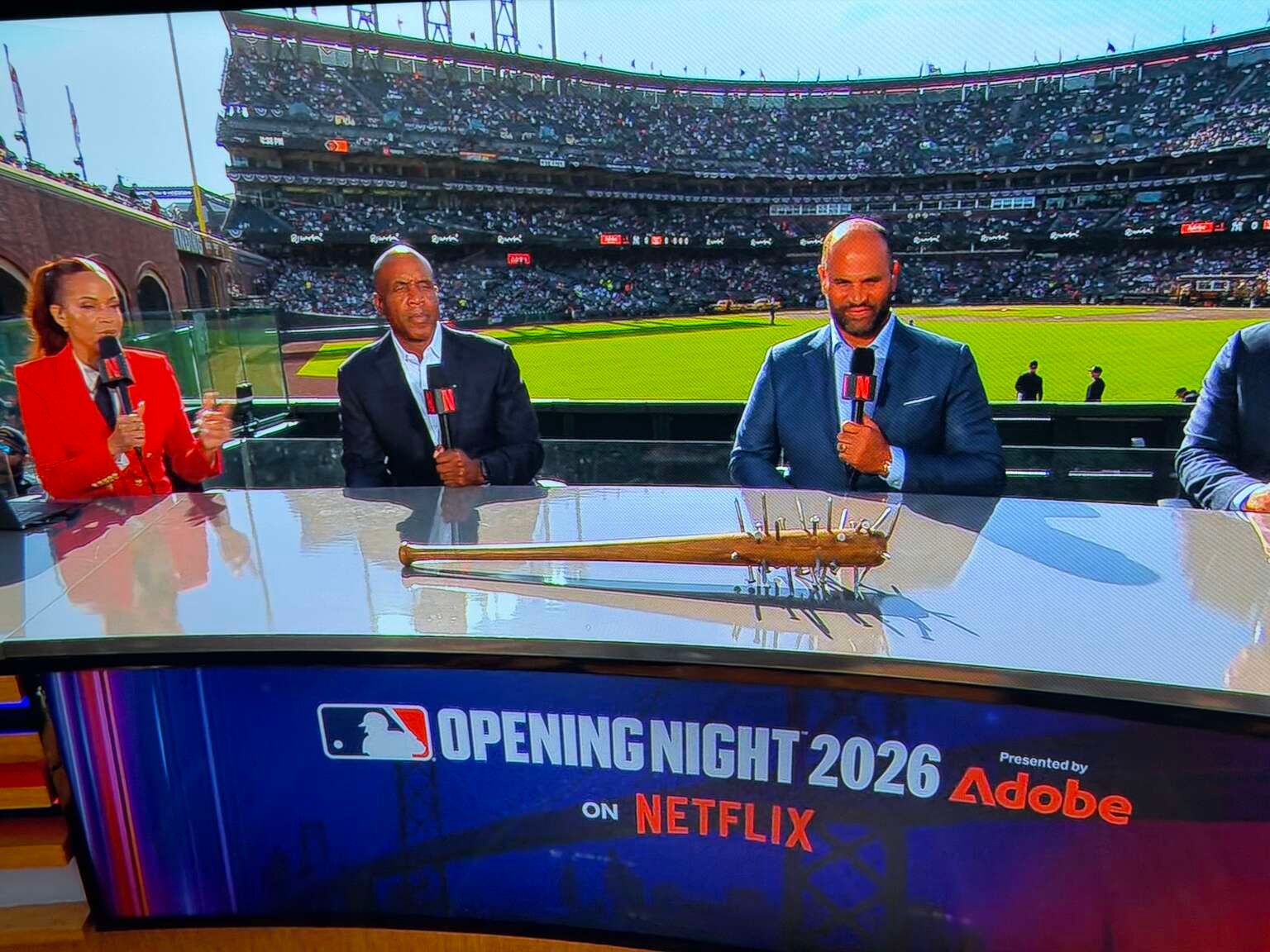
Click on image to see Barry and Albert’s confusion full size.
There were, no doubt, many traditionalists who rolled their eyes at the hamfisted promotions that the platform forced into the pregame show, but this is a major part of why the world’s largest streamer is willing to pay big bucks for one-off sporting events. If Netflix can make you watch baseball on its service, it is not going to miss an opportunity to remind you of what else it has to offer.
Netflix’s presentation and functionality
I watch more than enough sporting events to realize that the bigger the game, the further removed from the published start time it will actually begin. But when a game is billed as an 8:05 p.m. ET start, having 21 minutes of filler felt like Super Bowl-levels of excess.
First pitch for the game didn’t happen until 8:26 p.m., and I was relieved that we didn’t hit the bottom of the hour, despite the fact that I would have taken the over if given the chance. I’m not sure if that is Netflix, the Giants, or Major League Baseball’s fault, but for a sport that has seen marked and steady popular improvement over the past half-decade, waiting to start the first game of your season until a time when kids in the home market of one of the teams playing will only be able to watch a few innings before they have to go to bed is not a choice I would recommend.
Once the game got going, the visuals were pretty solid and conventional. The majority of the graphics and logos were crisp, if not non-descript, but they did have a somewhat non-standard score bug. Instead of being in the top corner of the screen and being more horizontally oriented, Netflix opted for a thinner, vertical bug in the bottom right of the screen.
While it took a minute to become acclimated to how the bug worked, after the first half-inning, it had been retrained to look in the corner for the information. However, because the bug took up significantly less space than some bugs and didn’t necessarily use the space it did have efficiently, the text was a bit too small, even on my 75-inch TV. I can imagine that on smaller screens, it was extremely difficult to make some of the components out.
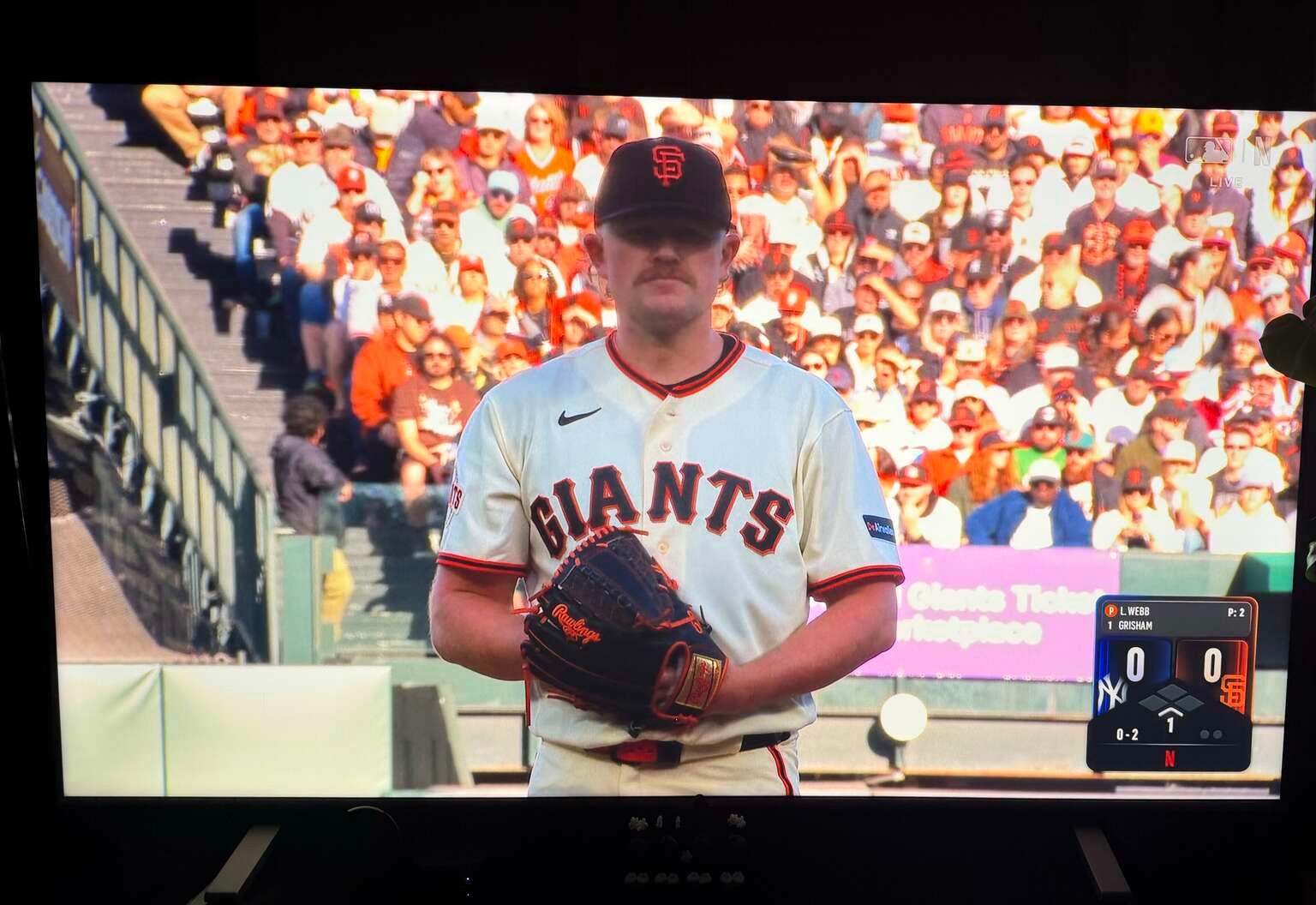
Click image to expand to full size.
Unsurprisingly for anyone who has watched any of Netflix’s other live sporting events — be they NFL Christmas Day games, high-profile boxing events, star-studded golf matches, etc. — the streamer does not scrimp when it comes to the number or quality of cameras. I was routinely impressed by all of the angles that the broadcast had when it came to breaking down individual plays. While I do not pay for Netflix’s 4K Premium tier, if you had told me that some of the close-ups they showed of first base on bang-bang plays were in 4K, I would have believed you.
Unfortunately, that did not correlate to some of the things that have become commonplace for broadcasters who cover sports on a more frequent basis. Whether it’s baseball backstops, hockey boards, or basketball stanchions, broadcasters have become adept at imprinting rotating, digital advertisements on real-world surfaces that are only visible to TV viewers. This technology is so good that, in most cases, it is impossible to tell whether an ad is actually on the surface or not… that was not the case on Wednesday night.
The Netflix broadcast struggled with left-handed hitters standing in front of their greenscreen ad placement. Whether it was a red Adobe banner or a pink one from T-Mobile, anytime a player crossed in front of it, we ventured into the uncanny valley. It wasn’t too egregious at first; it just made players look like late ’90s meteorologists forecasting a high-pressure system coming over the next few days. However, it did become a bit of a problem when it began decapitating catchers in the middle of at-bats.
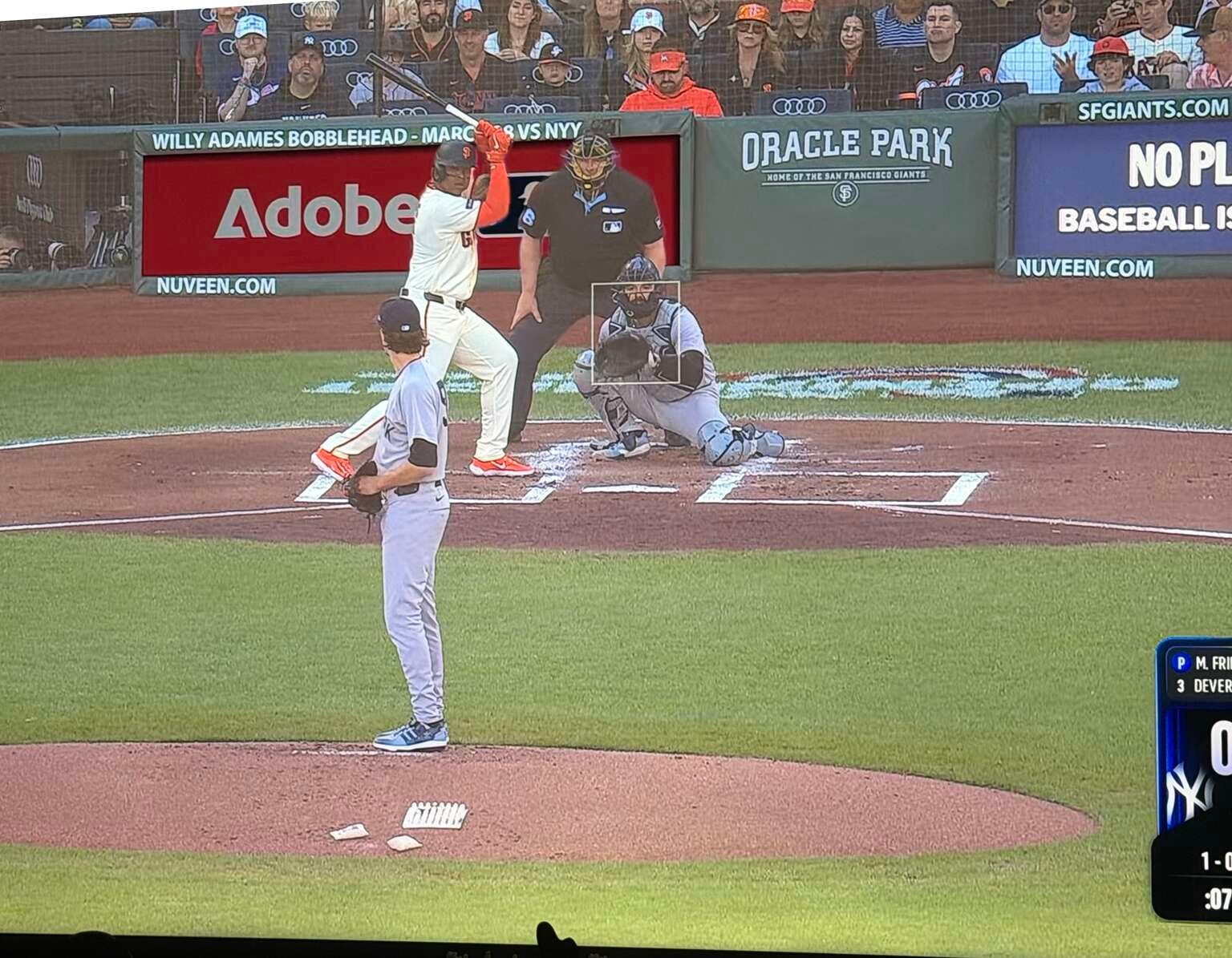
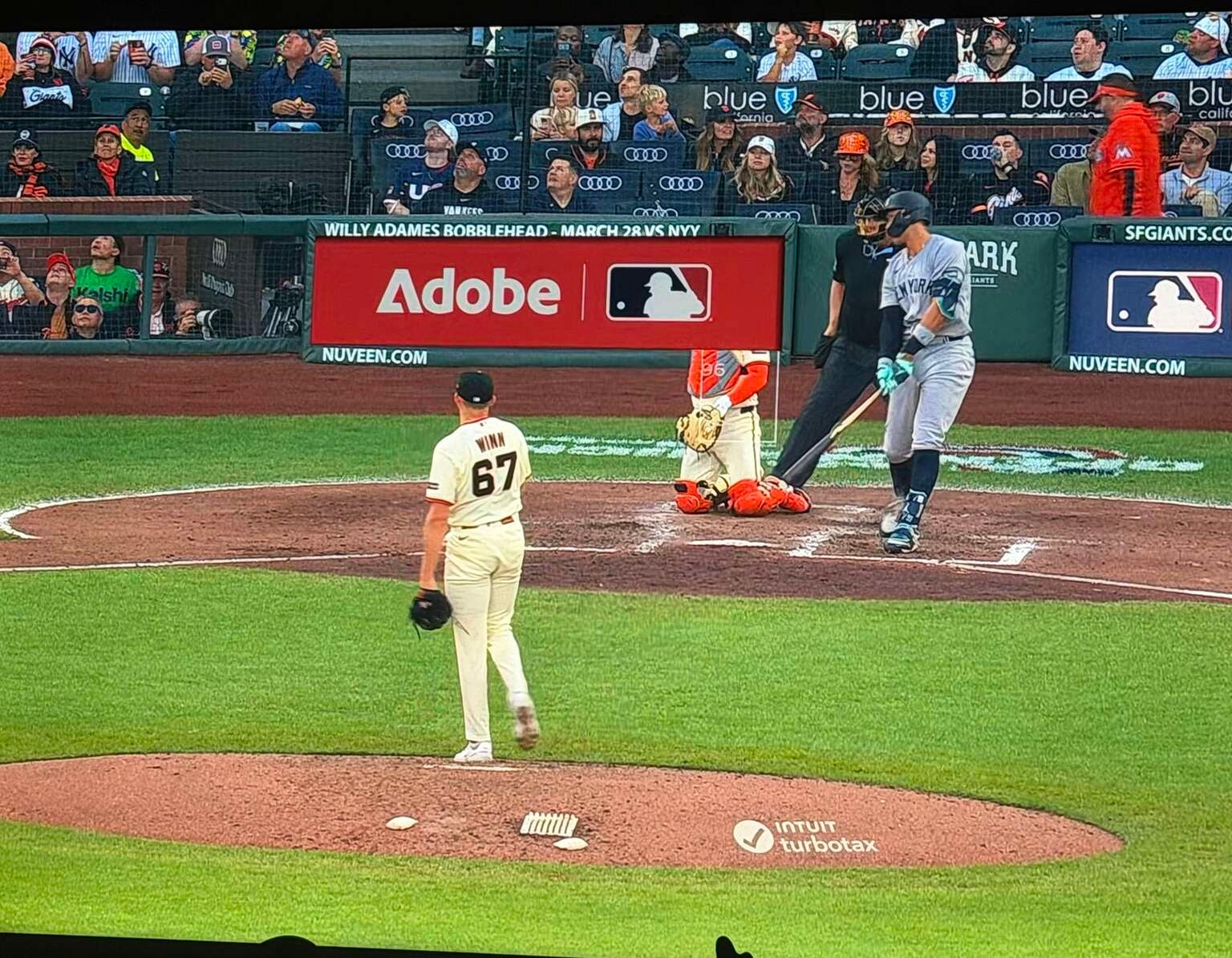
Click images to expand to full size.
Aside from the visual component of the broadcast, there were a few audio issues at times, including at the top of the pregame interview between reporter Lauren Shehadi and Giants’ first-year manager Tony Vitello, and when Barry Bonds joined the booth later in the game.
There was also an unfortunate timing issue when Vitello joined Shehadi at the top of the third inning for the always-unnecessary mid-game coaches’ interview. While the short chat itself was fine, it ruined a historic MLB moment that, unfortunately, fans at home were unable to experience.
As the manager and reporter were talking, Yankee hitter Juan Soto became the first player in Major League Baseball history to challenge a ball-or-strike call using the new ABS system. Home plate umpire Dan Bellino had called the Logan Webb pitch a strike, but Soto thought it was up and out of the strike zone, so he tapped his helmet to initiate the review.
As sports fans are familiar with in soccer’s VAR and tennis’ Hawkeye system, the best part of the digital review process is seeing the result in real-time with the players. Unfortunately, because Netflix was stuck in a split screen, no one in the truck either realized what was going on, or they were too scared to switch off of the manager.
Therefore, it was left to veteran play-by-play man, Matt Vasgersian — long one of the best in the business — to explain what happened after the fact, without the benefit of the cool visuals that go along with the new process. Unfortunately, that was the only challenge by pitcher, catcher, or hitter on the day, so fans didn’t get a chance to experience it on Opening Night. While I know that Netflix only hires well-seasoned and highly capable production crews, I can’t help but think that a team that works together more often might have understood the importance of the moment and found a way to better share that with viewers.
Overall, the visuals of the broadcast were on par with what you would expect from an Opening Night broadcast. However, the streaming functionality left a little to be desired. If Netflix is going to continue to invest in high-profile sporting events, it needs to spend some time on making it easier for fans to navigate the broadcasts.
While other streamers are incorporating stats, catch-up highlights, and tons of other added features to make the experience of watching games and events easier and more engaging, Netflix rolled out the most basic setup possible. When you stream a movie or TV episode on Netflix, if you want to rewind or fast-forward, it gives you an incredibly helpful series of images that allow you to scrub through the timeline and find what you are looking for easily.
However, during the Opening Night broadcast, you were left to guess where you would end up if you needed to find something in the broadcast. While Netflix did provide “Play from the beginning” and “Watch Live” buttons, if you wanted to go back and watch a specific play, or wanted to fast forward just to see Aaron Judge’s at-bats, for example (Yankees fans, I caution you not to do this for Wednesday night’s game), you had no way of doing this.
I know putting inning demarkations in the timeline might be too much for part-time sports broadcasters like Netflix, but at least allow your sporting events to have the same functionality as the shows and movies that you hawked endlessly throughout the broadcast.
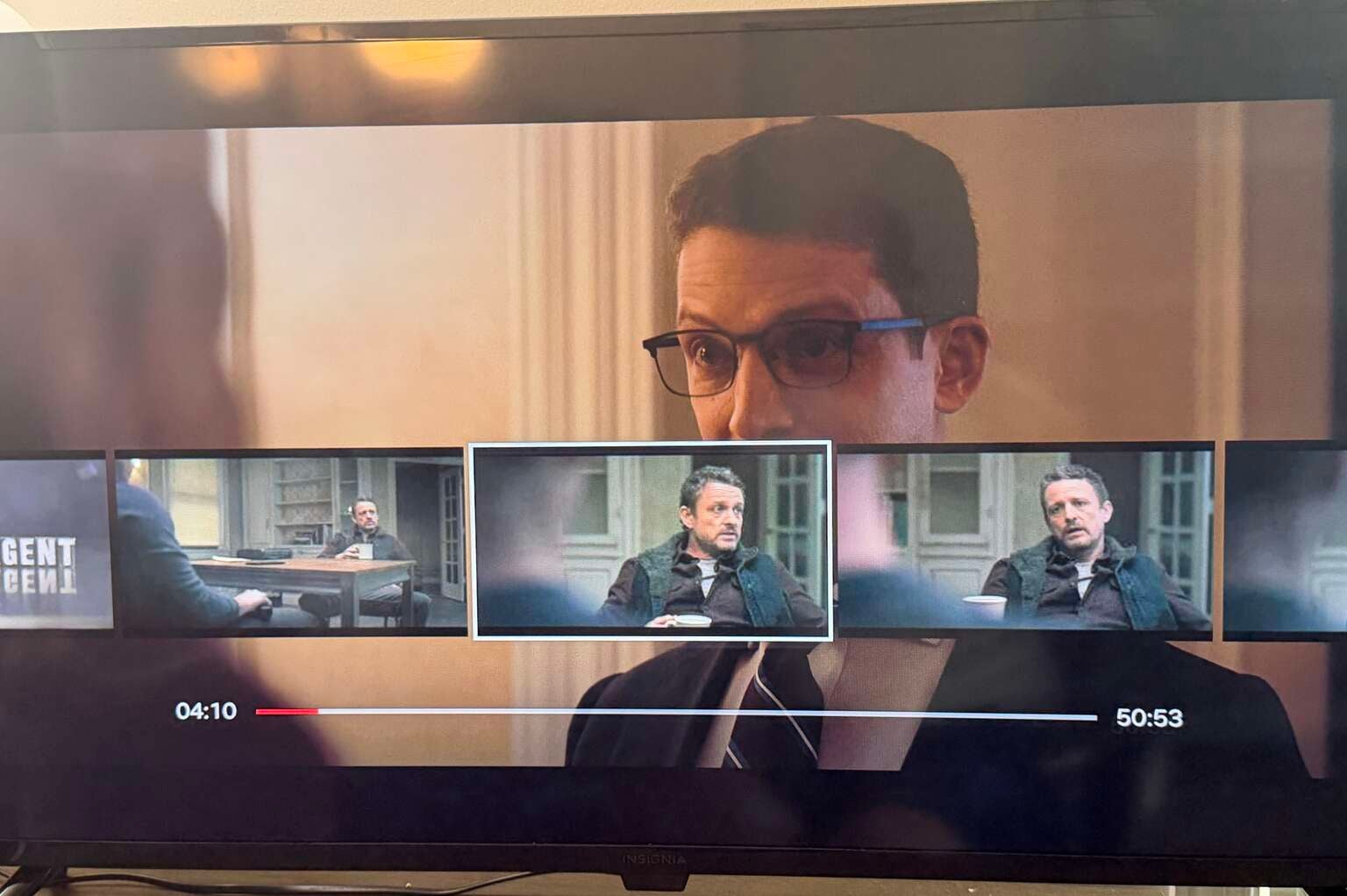
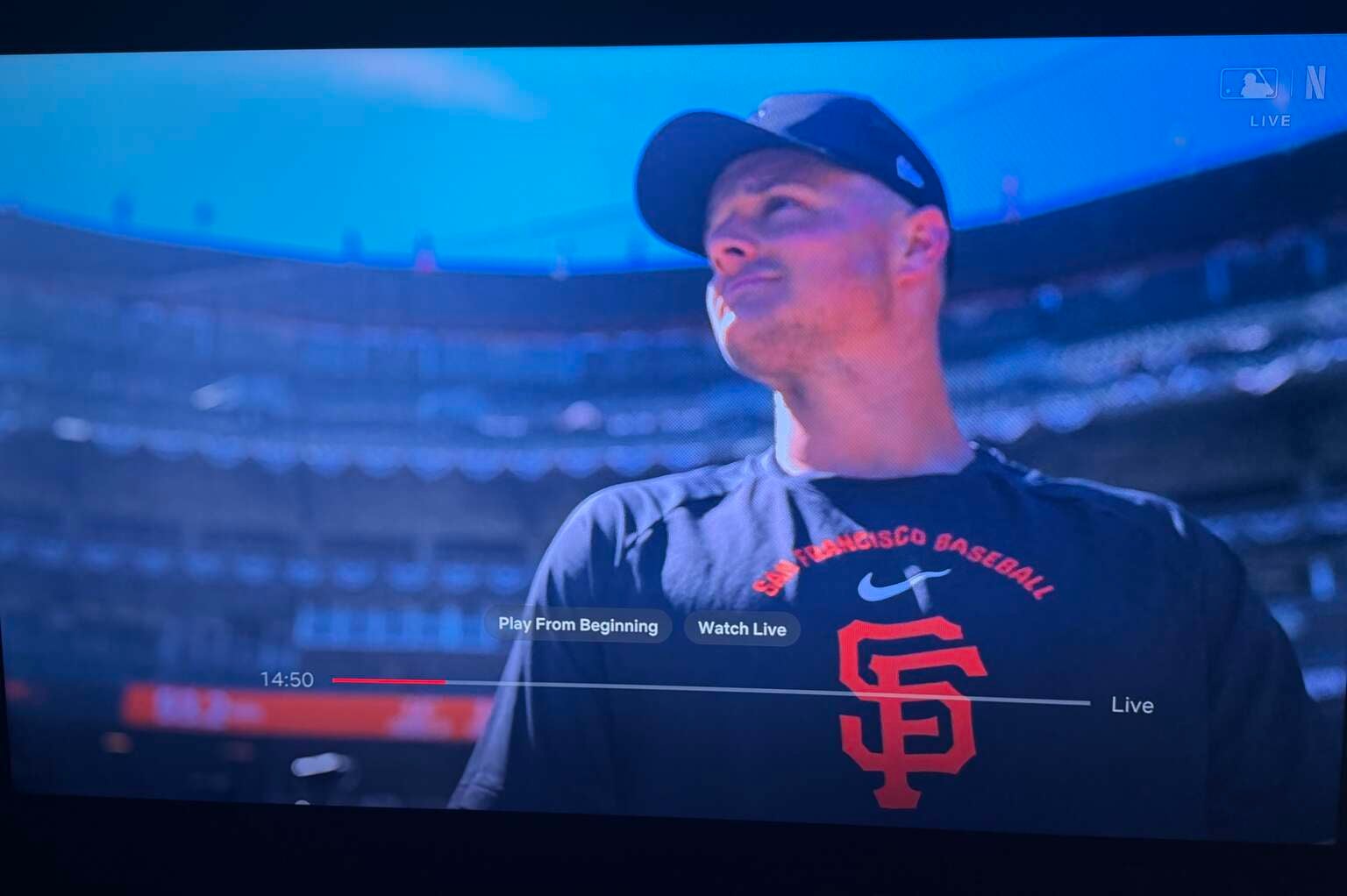
Click to expand images to full size.
The actual game broadcast
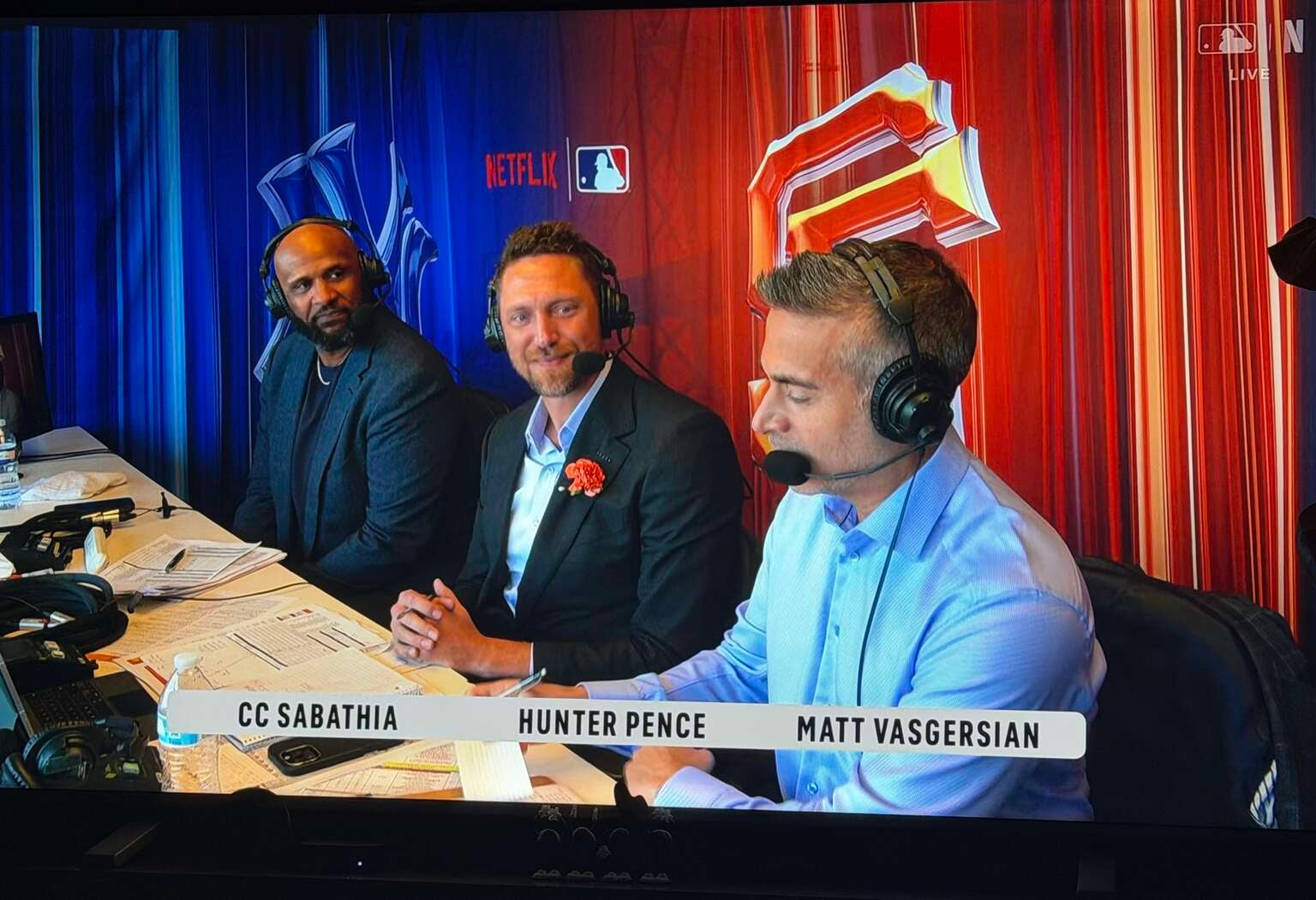
Click to expand to full size.
As I mentioned before, Matt Vasgersian has been one of the best baseball broadcasters for the past 20 years, and in addition to his Netflix announcing duties, he will also serve as the primary play-by-play voice for Peacock’s “MLB Sunday Leadoff” games this season. In the booth with a new crew for the first time, Vasgersian was the steady hand you’d expect; the perfect anchor for Netflix’s new foray into baseball. He was joined by analysts Cy Young winner, World Series champ, and Hall of Famer CC Sabathia, and four-time All-Star, two-time world champ, and Giants’ legend Hunter Pence.
The dynamic amongst the team felt comfortable, if not yet fully cohesive. Pence, who has been the Giants’ color commentator for the past five seasons and works with the MLB Network, was smooth with his delivery and brought useful insight to the game and the hometown team.
While Sabathia has done studio work and guest appearances in the booth in recent years, he doesn’t have the amount of experience on the mic that Pence does, and it showed around the edges. However, his enthusiasm for the game and wealth of knowledge made him an excellent counter to Pence’s more polished approach.
Overall, it does disappoint me a bit that this team was only assembled for a single game — future Netflix opportunities notwithstanding — because I felt that with the steady leadership of Vasgersian, it could have blossomed into a fun triumvirate.
Why did they do that?
I understand that Netflix wants to make every element of its sports broadcasts into a spectacle; that is the Netflix way, after all. So some of the shenanigans that the streamer got up to on Opening Night were of no surprise. They didn’t all land especially well, but I didn’t mind the effort. I am pro-fun and anti-stodginess in all things, but especially in sports, so I appreciate the swings that Netflix took, even if a few of them led to embarrassing strikeouts.
The first strange choice that the broadcast made was by including New York Giants quarterback and Heisman Trophy winner Jameis Winston. Aside from the name of his NFL team overlapping with the two baseball clubs competing on Wednesday, there didn’t seem to be an obvious reason to have him as part of the broadcast.
Winston did play baseball at Florida State and competed against Yankees starting pitcher Max Fried in a showcase game, but he certainly wasn’t brought in to add baseball insight; that’s not to say he wasn’t entertaining.
The QB displayed a bit of unhinged silliness throughout his time on air, punctuated by an absolutely perfect joke delivered by Duncan at his expense. While discussing the food offerings available at one of Oracle Park’s popular eateries, Duncan warned Winston to stay away from the crab legs. It was relatively subtle, but definitely a hilarious IYKYK moment that the anchor likely couldn’t have gotten away with on ESPN.
The Jameis Winston Experiment also included a fun moment with an elderly Giants fan, WWE superstars Jey Uso and Jacob Fatu, and Cracker Jack. But things really got out of hand after the game, when Winston and Shehadi presented the players of the game with custom Netflix letter jackets and… for some reason… hotdogs.
Fried and Yankees centerfielder Trent Grisham earned the honors and were presented with a handful of hotdog options by Winston, who wondered aloud if either player was a glizzy gobbler. The confusion and, honestly, horror, on the players’ faces was comical enough to save the segment from being an absolute trainwreck.
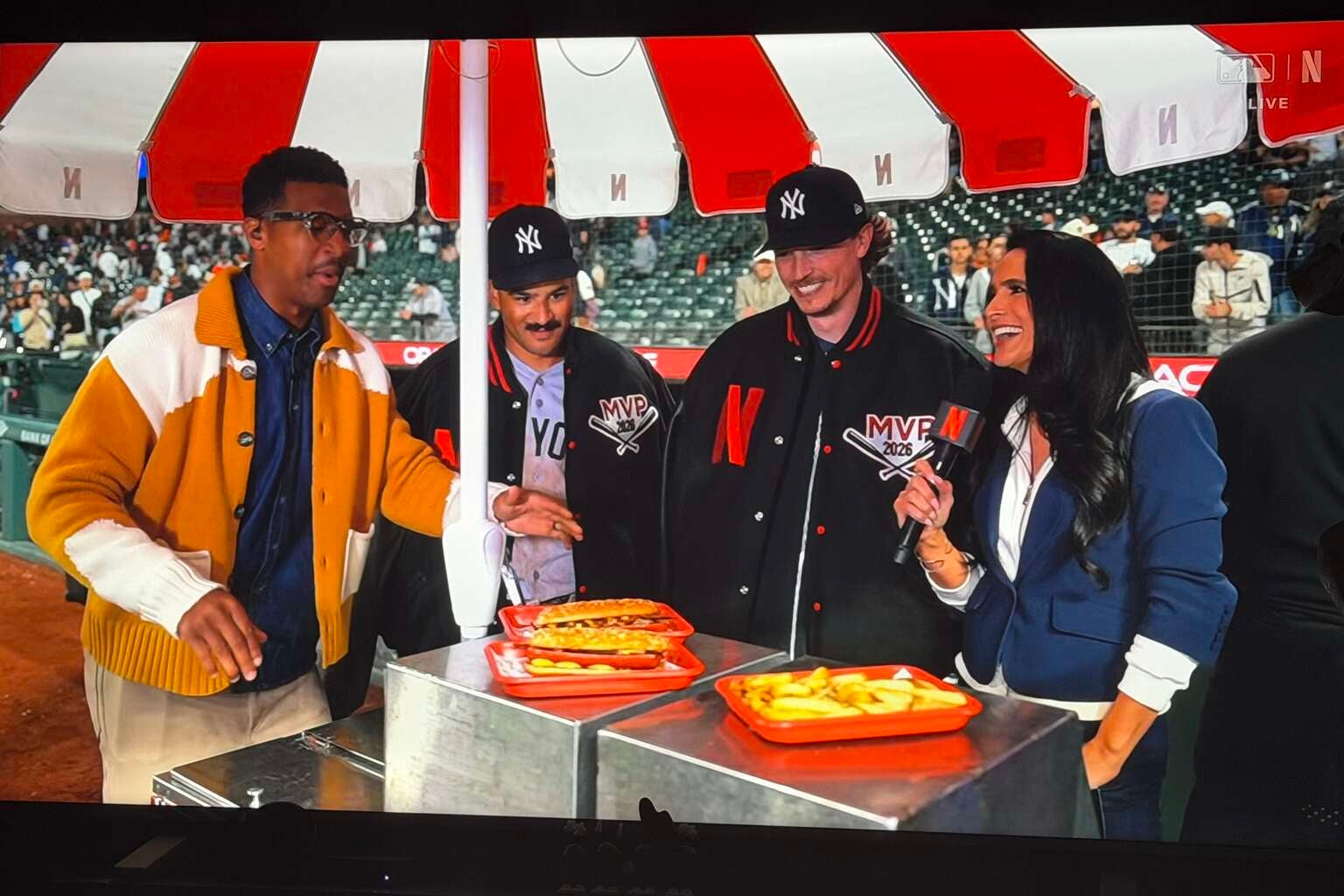
Click on image to expand to full size.
The verdict
As I said before, I am predisposed to being caught up in the emotions of Opening Day. I live for the nostalgia and sentimentality of the game I grew up loving, and I revel in the history and traditions that baseball prides itself on. However, with those deeply held ties come expectations. I expect any broadcaster who takes on the responsibility of Opening Day to rise to the occasion and understand and celebrate how special those moments are.
Despite the rough edges, the timing issues, the missed moments, the occasional glitches, there was something undeniably compelling about Netflix’s approach to the game. They certainly didn’t get it all right — I am still questioning many of the choices, large and small — but the effort and understanding of the circumstances were clear, and I appreciated that.
Opening Day has a way of covering up imperfections, and Netflix benefited from that glow. But more importantly, the ubiquitous streamer showed flashes of what its sports broadcasting efforts could be if it ever took on full-time broadcasting responsibilities. Netflix is not ESPN, it is not TNT, it is not CBS, it is not NBC. A broadcast on Netflix should blend high-level production with personality, looseness, and a willingness to try things traditional networks wouldn’t go near with a 10-foot pole.
It wasn’t perfect; not even close. But for a first at-bat, Netflix made solid contact and hit a few balls hard enough to suggest there might be something real here if it can clean up its fundamentals.

Netflix
Netflix is a leading subscription-based video streaming service that offers on-demand access to an extensive library of over 3,000 movies, 2,000+ TV shows, and a growing collection of acclaimed Netflix originals. Renowned for producing groundbreaking content, Netflix has become a cultural powerhouse with hit originals like “Stranger Things,” “Wednesday,” “Squid Game,” “The Crown,” “Tiger King,” “Bridgerton,” “The Witcher,” and “Black Mirror.”