Interview: New Phoenix Suns Streaming Plan on Hold, but Kiswe Still Innovating in Direct-to-Consumer Services
Interview: New Phoenix Suns Streaming Plan on Hold, but Kiswe Still Innovating in Direct-to-Consumer Services

It is an uncertain time for anyone working in regional sports broadcasting, as the ongoing glut of cord-cutting is turning the economic prospects for the entire industry on their head. Regional sports networks (RSNs) are shuttering and parent companies are going through bankruptcy proceedings as broadcast and streaming rights are being shifted from cable channels to broadcast networks, and teams and leagues are taking back rights that had previously been licensed to failing media companies.
One of the more interesting developments in the ongoing collapse of RSNs has been that teams have been increasingly signing rights deals with local, over-the-air broadcast networks. The LA Clippers announced a deal to air a handful of games on KTLA ahead of last NBA season, the WNBA signed a deal to air Friday night games on Ion, and the NHL’s reigning Stanley Cup champion Vegas Golden Knights will broadcast all non-nationally televised games on EW Scripps' local affiliate KTNV starting this fall.
Another such move was announced in late April that would see the Phoenix Suns and Mercury team up to air their regular season games on three Arizona broadcast channels and stream games with the help of video technology company Kiswe. Within hours of the announcement, Diamond Sports Group (DSG) — which owns [Bally Sports Arizona], the current RSN broadcaster for Suns’ games — said that the deal breached its contract with the NBA team.
While the plan with the Mercury moved forward at the start of the WNBA season this spring, things are on hold with the Suns, as the team and DSG work out their current contract details.
“There was maybe a misalignment [in] understanding between the Suns and Diamond as to how [the contract] worked. And I think that it got a little bit more confusing in the context of the automatic stay, once Diamond declared bankruptcy,” Kiswe chief strategy officer Mike Schabel told The Streamable. “All of the work that we were doing was in the context of what we were told we were allowed to do … We are at the ready to support any team who has a need for local, direct-to-consumer [and] has the rights available.”
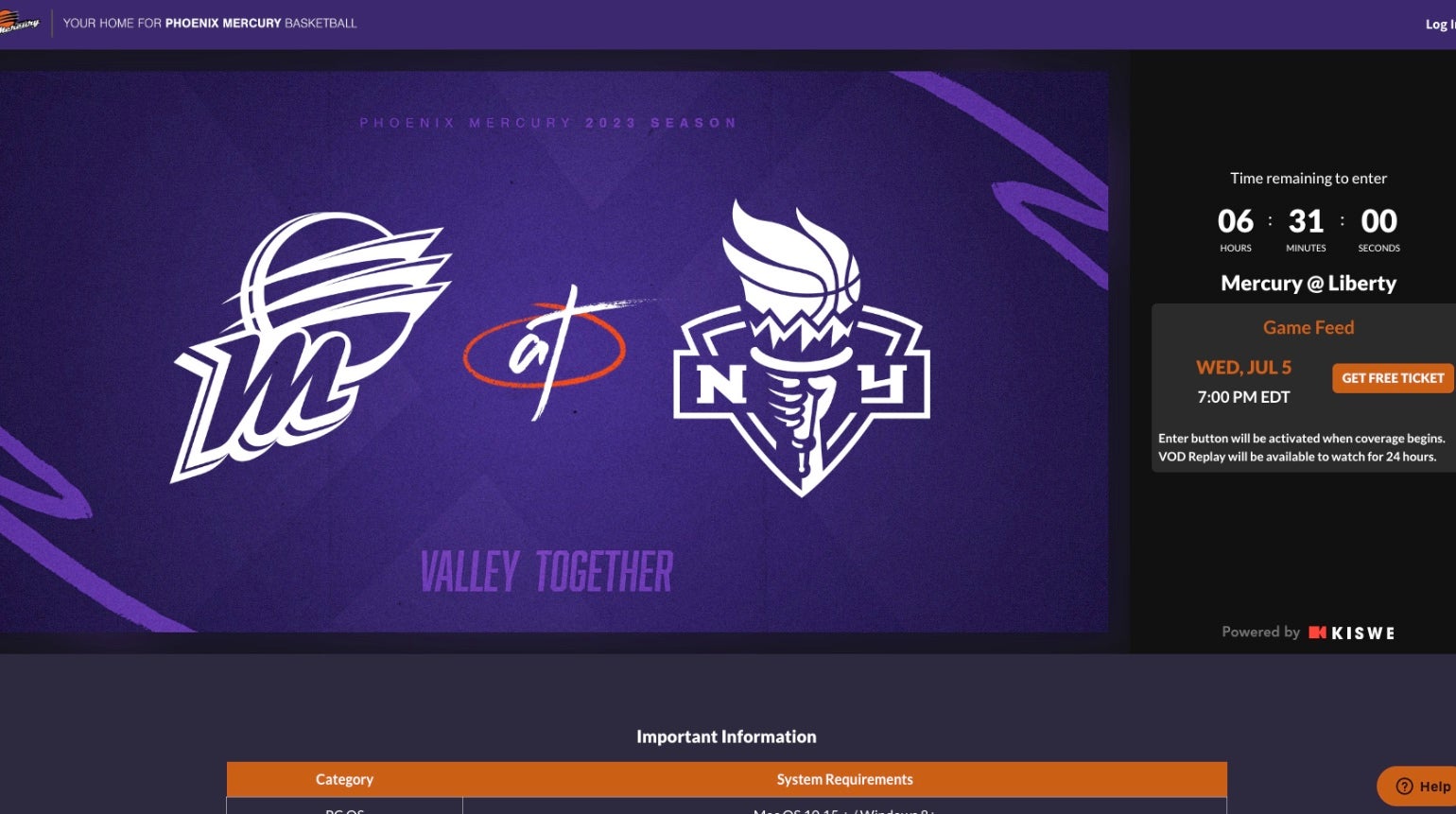
While the deal to stream Suns games is on hold until the situation with Diamond works its way through bankruptcy court, Kiswe has been powering the live, local streaming of Mercury games over the first two months of the season. Those games are broadcast exclusively through the team’s website to in-market fans only, with a video-on-demand replay available to watch for 24 hours following each game.
| DIRECTV | Fubo | Hulu | Philo | Sling TV | YouTube TV | |||||
|---|---|---|---|---|---|---|---|---|---|---|
| Free Trial | Free Trial | Free 3-Day Trial | Free Trial | Save with Sling | Free Trial | |||||
| $20.99 | $9.99 | $28.99 | $25 | $19.99 | $29.99 | $45.99 | $45.99 | $64.99 | ||
Kiswe, which has been in the video industry for a decade, works with all types of rights holders to bring engaging, groundbreaking video products to fans. The company works with major international pop stars like BTS, social media content creators like Smosh and the Try Guys, and numerous sports teams and leagues around the world. While the types of content owners and creators that Kiswe works with vary, the company’s focus remains the same.
“We’ve taken the approach that they’re going to be excellent at singing, dancing, playing a game, operations of their league, etc., and we need to pick up the rest,” Schabel said. “We have to be awesome at audience engagement and [fans] have to feel like they’re a live participant in the event. That doesn’t mean just throwing out a poll every once in a while, it means they have to feel like they’re part of the audience, just like when you’re at a game. So that is our complete fan engagement thing.”
Since the company’s founding in 2013, Kiswe has been hyper-focused on helping content owners super-serve their specific audiences. Even as the streaming revolution was still in its early stages, the company saw how the interactivity of video on social media would lead to the next innovation in broadcasting, according to Schabel.
Having spent significant amounts of time observing and studying how audiences interacted with content on platforms like YouTube, Twitch, and TikTok, the company is actively taking the lessons learned from those platforms in order to bring the best ideas to the professional content that it helps deliver.
“In order to do that, we have to give bespoke content. It has to be personalized, which means we can’t just do one thing for all, Schabel said. “We have to produce different types of live content for different demographics. Young people, Spanish-speaking, different languages, if they’re interested in betting … they all have different frameworks and lenses through which they are interested, and we can go personalize the content for them.”
Kiswe’s cloud-based production allows the company to deploy all of these specialized focuses at scale. While Kiswe’s new partnership with the Mercury is currently front and center, perhaps its most successful sporting experience is in large-scale pay-per-view events. Kiswe provides the backend for the direct-to-consumer (DTC) product from In Demand. The platform — which is owned by Comcast, Cox, and Charter — is the largest pay-per-view provider on cable and satellite in the United States.
The platform’s website ppv.com features Kiswe technology and allows fans to stream all types of pay-per-view events including top-flight boxing, professional wrestling, and more. While In Demand originally provided the infrastructure for cable channels like Showtime and rights holders like Premier Boxing Champions to provide their own PPV events on cable and satellite, as well as their own individual streaming services, Kiswe has made those same events available to stream from one centralized location with a unique digital presentation.
How the company approaches each individual event depends on what the content owners are looking to achieve and how that specific audience likes to interact with the events. From there, Kiswe tries to determine what features will make viewers feel more connected to the event than they could through a traditional broadcast.
“If you’re getting [a broadcast] over the air through an antenna, there isn’t a straightforward, easy feedback mechanism for which you can participate unless it’s a second screen type solution,” Schabel explained. “On digital, I have a two-way communication tool. So now I have a network, it can go back and forth. And because of that, then you can create a different experience for viewers … Each league is a little different; their fan bases are a little different, what their capabilities are are a little different, and what their interests are is a little different.”
For example, when working with the Ironman triathlon, Kiswe provides streaming viewers the ability to watch all of the available cameras and select which parts of the race or which competitors to focus on. While that is not yet available in their local sports broadcasting options, it likely will be in the future.
The company also tries to find ways to allow fans to become involved in the content in between the action, just like they would be if they were actually in the arena or stadium. From short, five-second reaction videos to sponsored segments similar to in-stadium Kiss Cams, allowing the audience to be a part of the experience allows them to feel more connected to the event and therefore, more invested in this specific viewing experience.
Kiswe has tools built into its product to prevent inappropriate viewer-submitted content from making it to the broadcast, which is important because these types of engagement drivers can be revenue-generating opportunities for content owners.
“We think about monetization opportunities in this industry traditionally around subscriptions and ads,” Schabel said, “But when you think about that interactivity and that engagement, that creates unbelievably valuable advertising inventory. We’ll put you on our Kiss Cam, or our virtual fan camera if you do something with a sponsor.”
As cord-cutting continues to eat away at the carriage fees that sports teams and leagues can bring in, these types of unique partnerships will be invaluable to making up the lost revenue for everyone involved moving forward. However, while Schabel knows that the economic model is changing across the landscape — and especially for RSNs — he doesn’t believe that the money has completely disappeared, it is now just coming from a wider variety of sources.
“I’m excited about how the over-the-air broadcasters are reentering the sports space,” he said. “Everybody says we’re going back to the old, but we’re kind of going back to the old plus the new, because we’re adding the DTC as well. It’s not that the revenue model is impacted in the total dollars … the revenue model just shifts to different buckets. So now, instead of being purely subscription based, there are elements of subscription, and it’s ad-supported, and then there’s pay-per-view and subscription on DTC. So you have different elements coming together, which I think formulate the [new] revenue chain. And I think these things are awesome because they drive innovation, they drive best practices, they drive value.”
Schabel believes that these types of fractured revenue models will lead to more and more creative partnerships and potentially further mergers and acquisitions in the future, but the ultimate goal needs to be about trying to find the best way to meet audiences where they are. When it comes to regional sports, he believes that video providers have an advantage, because of the connection that viewers inherently have with the teams.
“When you’re in local sports, and you’re doing game after game after game, the probability is that the person who enters the event, you’ll have seen before,” Schabel explains. “So you start to be able to form virtual relationships … So, as a result, we are continuously looking at all of the interactive feature functionality we have, as it pertains to this virtual community becoming an actual community because they’re both local. So you want to be able to foster that type of thing; the features are not there [just] to be special features. They’re there to be able to create the environment to allow those community relationships to happen because then that just reinforces the value of the brand.”
Across brands, events, leagues, and teams large and small, Kiswe believes that the future of broadcasting is in finding ways to have viewers lean in and participate in the video on their screens in some form or fashion. Not only will this heighten their connection to the product and keep them subscribed and tuning in longer, but it also will allow for new, creative monetization opportunities. As the regional sports broadcast industry continues to become more and more fragmented, it will likely take this type of innovation to keep games on the air moving forward.